If Chennai can claim any resemblance to an established alt rock scene in the city, a good chunk of that credit has to go to a band like Skrat. They have held out, survived the blizzards of lineup changes, a dearth of good audience and the hazards of taking a break in a very weak environment. They have taken their time to make music which screams in your ears that it’s Skrat, and nothing else: for example, take ‘Black Hammer Man’ or the ever-popular ‘Stay Wild’. Skrat is a band that has been courageous enough to take the time to find its own ‘sound’.
And that’s exactly what the band did, with Skrat in the Shed.
Skrat in the Shed is essentially a seventeen-minute, five song video showcase (see above) of Skrat playing five new songs, shot and recorded in front man T. T. Sriram’s ‘garage’, the jam room for many Chennai bands. Their first song “Tin Can Man” starts on a promising note with well-matched vocals and a foot tapping chorus. If that wasn’t enough to catch your attention, then the fast paced “Smoke a Cigar” grips it. The song is well-written and accompanied by catchy riffs, and the change of pace in the middle of the song is just brilliant.
It does look like all songs were performed in one go, with only a few tight seconds for demarcation. After “Smoke a Cigar”, we settle down to a nice and leisurely “Big Bad Bombs”. At just about four minutes long, this track has some soulful vocals and restrained drumming to go with it.
The next song “High” already seems like the next crowd favorite. Its low toned, deep and measured riffs sound like Tony Iommi cured of his lymphoma and back from his Sabbath-ical. On Skrat in the Shed, it is this song that reminds us most about just how much Skrat has striven to evolve and mature, tired of everyone telling them how to play their music. This slow paced song, presented with elegant vocals and good bass, is sure to have your heads rocking slowly in harmony with its title.
Bringing things to a fast paced end, leaving you craving for more is “Shake It Off”. Again, good guitar work does the trick here. Although old timers might question Sriram’s vocalizing of the lead tune, it’s still fun: and still Skrat in its own way. And what more, it worked with the audience which sang along when they performed at Alliance Francaise, Chennai recently.
All in all, Skrat in the Shed is a great album (and a neat video) by Skrat. They look all set to hit the mainstream and play regularly to bigger audiences. You have to be very determined and lucky if you get to make a successful comeback and reinvent yourself in the process. And Skrat looks like they’ve given their all.
This is the perfect pop song. It is not the first perfect pop song that I have come across, it won’t be the perfect pop song in about a week from now, but for now it is and you must know about it.
Start at the beginning and watch the video. Firstly, it is a great music video and secondly it lets us discuss the surface of the song. This is unapologetic pop. The singer is a very pretty girl in her young twenties, which is a good thing, in case you suspect me of more hipster-ness than good sense. You can hear the Lady Gaga and Gwen Stefani influences and there is more upbeat energy in three seconds of this song than I have managed in my entire life. Good, solid, unapologetic pop all the way though.
Now though, go a level deeper and listen to the lyrics. You don’t have to. This is a pretty good pop song even without them and you are free to enjoy the song however you like. However, take a moment and hear what she is actually saying. There are plenty of rip currents of depression running through this pink sea of happy pop. She may be singing that she’s going to fail and she’s going to die with the same smile that she has when singing she’s going to live and she’s going to fly, but you know that she is as earnest about the one as the other.
This is also a pretty intelligent record. The chorus of “I know exactly what I want and who I want to be” speaks layers about who she is and “The nod and a wink of TV told me how to feel, now real life has no appeal” followed by the repeated “No appeal” is easy to empathize with. More than that though, every time you watch the video (and I have watched the video many times indeed, did I mention how pretty she is?) you can validate a completely new interpretation of the song when you pair it with who the singer is. That for me is the borderline that separates intelligent art from the rest, when you can argue the nuances of its meaning.
Verdict:This is the perfect pop song. For now, everything should be this song. One week from now, I may be listening to something else, but as of now, this is what all pop should be.
Recently, we were pleasantly surprised to hear some happy news about a good friend of ours, which pertains to the topic at hand. Naturally, as soon as we heard the news, we realized the golden opportunity to create this very Top Five List. The songs we’ve chosen here are both insanely catchy and supremely well-known: in short, classics. For each song, we provide you with the excerpts of lyrics that, when put together, make up every good classic love story. We’d like to point out that the order of the songs traverses the whole length of a happy relationship: from the initial fiery courtship to the lasting bliss of marriage. So, right to it then!
Song 1: Light My Fire, by the Doors [1967]
The time to hesitate is through
No time to wallow in the mire
Try now we can only lose
And our love become a funeral pyre
Come on baby, light my fire
Come on baby, light my fire
Try to set the night on fire, yeah
Song 2: You Really Got Me, by the Kinks [1964]
See, don’t ever set me free
I always wanna be by your side
Girl, you really got me now
You got me so I can’t sleep at night
Yeah, you really got me now
You got me so I don’t know what I’m doin’, now
Oh yeah, you really got me now
You got me so I can’t sleep at night
You really got me
Song 3: I’m a Believer, by the Monkees [1966]
I thought love was only true in fairy tales
Meant for someone else but not for me
Love was out to get to me
That’s the way it seems
Disappointment haunted all my dreams
And then I saw her face
Now I’m a believer
Not a trace of doubt in my mind
I’m in love, I’m a believer
I couldn’t leave her if I tried
Song 4: Some Kind of Wonderful, by the Grand Funk Railroad [1974]
I don’t need a whole lot of money
I don’t need a big fine car.
I got everything that a man could want
I got more than I could ask for.
I don’t have to run around
I don’t have to stay out all night.
‘Cause I got me a sweet … a sweet, lovin’ woman,
And she knows just how to treat me right
Song 5: All You Need is Love, by the Beatles [1967]
Love, love, love, love, love, love, love, love, love.
There’s nothing you can do that can’t be done.
Nothing you can sing that can’t be sung.
Nothing you can say but you can learn how to play the game
It’s easy.
There’s nothing you can make that can’t be made.
No one you can save that can’t be saved.
Nothing you can do but you can learn how to be you in time
It’s easy.
All you need is love, all you need is love,
All you need is love, love, love is all you need.
Susmit Sen has been India’s foremost acoustic guitarist for over two decades now. Founder-member of the great Indian band Indian Ocean, the band’s signature sound is built upon Sen’s unique guitar sound: Indian sensibilities, but a purity of scale that reigns supreme. Heavily influenced by Ustad Ali Akbar Khan (sarod) and Nikhil Banerjee (sitar) as well as the great John MacLaughlin in equal measure, he has developed his own unique sound which, albeit not technically pure, is extremely clean. His compositions are in the classical mold, but not in method, where melodic lines are woven around the whirr of open strings.
Over the years, Indian Ocean’s sound has changed. The first album had only instrumentals, which was almost unheard of then in the Indian music industry. As the years have progressed, the band has incorporated vocals and lyrics, folks and roots playing a huge influence, with the numbers generally being more pacey and more mainstream in its attire. And somewhere along that line, the inherent classicism of its first album has been somewhat lost. And this is where Sen’s album comes in. Susmit Sen released his solo debut album Depths of the Ocean earlier this year – an album which has been in the making for the last ten years.
The album kicks off with the track “Rejuvenation” with his bandmate, the great late Asheem Chakravarthy on vocals and tabla. At a little under ten minutes, the track starts off with Susmit building up the mood with some neat jazzy riffs and then Asheem takes over with his tanas – Kumar Gandharva’s influence is crystal clear. As Asheem and Susmit feed off each other in a jugalbandi of sorts, it’s a distinctively early Indian Ocean. And it’s rather sad that this might be the last time one gets to hear Asheem’s soulful voice on record.
Next up is “City Lights” featuring Shubha Mudgal. Much darker in mood, it is unlike anything Rana’s ever done before. The first distinct feature is Shubha Mudgal’s whispered and restrained vocals, which are as majestic as her usually more vigorous style. Though it’s more than 11 minutes long, it’s all good: the sudden mood changes and fillers, accompanied by some beautiful flute and fluent keyboard playing, makes this track the majestic best of the fusion genre. The track ends with some dark but poignantly beautiful note phrasing, and is an absolute classic.
The title track “Depths of the Ocean”, incidentally one of Susmit & Asheem’s earliest compositions, features Parikrama’s Nitin Malik on lead vocals and other vocalists. It harks back to the era of Indian Ocean’s earliest days and its debut album. With some very agreeable vocals, the guitar parts have been woven in very intricately and you can hear traces of quite a few numbers from the debut album in the various jumps and turns the songs take.
“Tribute” is a solo Susmit Sen guitar track and it is easily the most moving piece of this album. It takes one back to the times where to experience music meant sitting alone in a dark room and letting the music seep into the soul, with inner peace as the foremost objective. The beautiful aalap creates a wonderful mood as it segues into the main composition with a beautiful jhala. Again it is a long composition, and again it never gets repetitive. Sen comes up with some beautiful fillers without ever changing scale.
Next is the folksy “Wild Epiphony” featuring the Assamese folk musician Papon on lead vocals. Though Papon is pretty good on the vocals with some powerful delivery and with Rana in full form, it doesn’t quite have the majesty of the earlier collaborations on the album. Following that is the track “Intimacy” featuring Sen’s cousin Sari Roy. It is another beautiful track with some very melodious riffs and fills, and Sari Roy harmonizes along quite beautifully with the strains of Sen’s strings. And it does create some mood – imagine sitting around a moon-lit terrace, a tad intoxicated and listening to a couple of friends singing and playing the guitar. Except, of course, your guitarist won’t be as good as Rana.
The album ends with “Six String Salute”, Sen’s take on our 100-year-old National Anthem. Stripping the anthem somewhat of its patriotic fervour, it brings out its oft-neglected spiritual and tranquil calmness and enhances its melodic classic-ness even more. Susmit Sen truly does this piece full justice.
Depths of the Ocean is an absolutely stunning album. Susmit Sen comes across as a musician at peace with himself and his guitar. It’s the fruit of his arduous twenty plus years with his band, the sounds and sensibilities definitely contributing to the beauty of it. This album makes an emphatic statement: Susmit Sen is still India’s best acoustic guitarist. There’s an ethereal and spiritual connection with his music, that can take its listeners places, and this album crowns Susmit Sen in all its glory: not only as a great guitarist but as a great musician.
Verdict: Indian Oceans fan you might or might not be, just shut yourself in your room and listen to this album. And drown in the Depths of this Ocean of sounds. And peace out!
It’s not difficult to see why indie music is the focus of much ire and scoffing, no matter what the sub-genre. The broadness of the term’s definition itself invites more than an acceptable percentage of ‘artists’ who would have been – and should be – branded as rich suburban kids in less digital ages. Besides, there is a reasonable amount of mutual back-patting between publications and the type of bands that are expected to be liked by such publications – as a result of which there is often true confusion whether that DIIV or Lotus Plaza song you’re listening to is good because it’s good music or because it’s supposed to be good music. Y’know?
But, flimsy rant aside, July already seems to have been quite a decent month for the kind of indie music that can walk the talk, so to speak. Without further ado, Top Five Records presents to you five good new tracks of music. Just to be clear, these songs have melodies, lyrics, stories, even pop sensibilities, so fear not, we’re not pulling a hipster-style fast one on you.
5.Under the Westway, by Blur
Chiming in at number five are Brit legends and musical heroes Blur, with a brand new track that they’ve specially released for the Olympics Closing Ceremony. “Under the Westway” starts off with deconstructed beats, plinky piano and the kind of grand orchestral sweeps that are just perfect to play over slow-motion shots of athletic super-feats. While the subsequent melancholy of the song – both in Damon Albarn’s sad vocals and in the lovelorn-ballad-like piano – make the song seem unsuited for the closing ceremony of man’s greatest sporting event, it takes only a little thought to make sense of the song.
True, the lyrics are a little too sad for the Olympics. But there’s always a little shimmer of optimism that seems to shine through the music on this song. And both of these things put together mean this: “Under the Westway” is a song for both the winners and losers, as it should be. It is only apt that, music-wise, “Under the Westway” vaguely reminds one of “Let It Be”, because it means that Blur has got the elegant-grand-closing thing down pretty damn well.
4.Primadonna, by Marina and the Diamonds
On first listen, Marina and the Diamonds’ new single “Primadonna” seems to be a self-fulfilling prophecy sort of deal, as if Marina hopes to be considered a primadonna simply by singing about being a primadonna. It’s a pretty easy mistake to make – before the song even finishes a verse, Marina sweet-sings about how all she ever wanted was the world, and would you please propose to her right now, baby.
But the genius lies in two brief verses that Marina manages to slip in, that make it clear that this song is not a boastful claim of popularity, but a character sketch. “And I’m sad to the core, core, core/ Everyday is a chore, chore, chore/ When you give I want more more/ I wanna be adored,” sings she, no more a braggart but a storyteller. It is good to note that all of this happens while the synth-happy music allows you to completely block out the lyrics if you wanted to. Plus, she possesses Gwen Stefani’s I’m-genuinely-cooler-than-you twang in her voice. Really, it’s just good pop music.
3. Baby, by MIA
Everyone’s favorite Sri Lankan rebel princess MIA returns with a dark, slick gem called “Baby”, from her upcoming 4th album Matangi. It’s full of everything we love about her. She’s still her sometimes-quirky-sometimes-unruly self. She still has enough swagger to redefine what a pop song is meant to be. She still manages to put together the oddest of sounds and make it work. (Remember the cash register/gun shot combination on the chorus of “Paper Planes”?) “Baby”, like MIA, is polarizing. It has mucky beats, electronica that warns you of aliens, and half-seducing-half-chiding lyrics, so you know straight off whether you like it or hate it. And we happen to really like it.
2. Gun Has No Trigger, by the Dirty Projectors
“Gun Has No Trigger” doesn’t sound like a real song. What we mean is, it sounds like it could be a remix. There’s a guy belting out verse after soulful verse of old-school music, there’s the low hum of old-school female background singers, and then, at odds, there’s some striking, clearly modern drumming. But this isn’t a remix: this is the sound that the Dirty Projectors show off on their new album Swing Lo Magellan. The best thing about “Gun Has No Trigger” is that it sounds exactly like the background music during a Bond movie’s opening credits, and when you pair that fact with the song title, it seems like a stroke of genius.
Sidebar: The video for this song is brilliant.
1. Pyramids, by Frank Ocean
Last year, Frank Ocean was an unknown R&B singer who was, strangely, affiliated with a violent young rap crew (Odd Future). Then, his mixtape Nostalgia Ultra came out and everything changed. Nostalgia Ultra was considered by many – including yours truly – to be the best thing that happened in music last year. So, this week, when Ocean flippantly announced that his first love was a man, went on Jimmy Fallon’s show and released his first album Channel Orange a week early, it propelled him to the biggest thing in music right now. Against this backdrop, it is easy for the public’s expectation of Frank Ocean’s new album to overshoot reality.
Thankfully, Frank Ocean seems to equal if not surpass what he did on that mixtape. The stand-out so far seems to be the ten-minute “Pyramids”. The hazy-slick beats and Ocean’s spectacular set of pipes take centre stage on first listen. But, like any good Frank Ocean song, that’s only the beginning. Slowly, amidst Egyptian-themed metaphors, the story unfolds: “Pyramids” is actually a fully fleshed out story about a whore called Cleopatra that the narrator – her pimp – seems to be enamored by. As if that wasn’t enough, there’s also a great John Mayer guitar solo to close out the song. Listen, now!
Sidebar 1: If you’re wondering what a pyramid has got to do with it, just check out the single cover art.
Sidebar 2: There’s a brief second or two where you think he’s going to segue into KC and the Sunshine Band’s “That’s the Way (I Like It)”. It is a pretty snazzy thing to do.
Agree with the top 5? Disagree? Let us know in the comments section!
Born and Raised is a pretty important album, career-wise, for John Mayer. The last few years haven’t been too kind to him. From gracing the cover of Rolling Stone in 2007 with John Frusciante and Derek Trucks as the new Guitar Gods to an almost-career destroying interview in the same magazine three years later, it’s clear to the public eye that John Mayer the celebrity has taken precedence over John Mayer the musician.
He once had it all: backing Jay-Z one night to jamming with Buddy Guy or B.B. King or Eric Clapton on another; forming a successful blues power band (John Mayer Trio); living it up with the ladies during his acoustic coffeehouse heartthrob phase. But he lost it all, and quite publicly, that too. In a whale of personal trouble, Mayer shut himself off from the world and started working on Born and Raised. And as for the inspiration, Mayer seems to have looked all over California, especially the Laurel Canyon folk scene of the late 60s and early 70s. Quite a few American iconic artists make their presence felt on this album, as do legendary American session men like Chuck Leavell (of The Allman Brothers Band), Jim Keltner and Greg Leisz. And that makes the album very interesting indeed.
As we’ve explained, California is all over the album. Aptly enough, the album kicks off with the beautiful country folk song “Queen of California”, a retro Laurel Canyon folk tribute that should be heard around a bonfire with a hip-flask in hand. As Mayer name-drops both Young’s After the Gold Rush (“Lookin’ for the sound of neon, hun/After The Gold Rush of 1971“) and Joni Mitchell’s Blue(“Joni want blue, a house by the sea“), the influences of the iconic songs are clear. Built on a vintage Grateful Dead groove and a classic Neil Young acoustic riff, it channels The Allman Brothers Band in its silky hooks and fills. Mayer’s in top form here, with beautiful vocals and soulful harmonies reminiscent of CSNY in all its glory, accompanied by some beautiful pedal steel playing.
On this album, John talks often of the decisions in his life. “The Age of Worry”, one such song, is a lyrical ode to fortitude. Starting off with some great acoustic picking, it segues into a plush string ornamental gusher, where Mayer’s recent acrimonious past seems to be heavy on his mind. On “Shadow Days”, backed by bristling lead guitar, shimmering piano and pedal steel (in the tone of mellow Southern Rock), Mayer is both confessional and a tad chastened about his past relationships. He admits to living in the vicious cycle of self-delusion with his relationships and paying for it: “It sucks to be honest/And it hurts to be real,” he confesses, going on to insist that, on the brighter side, these experiences have given him self-forgiveness and self-acceptance.
The title track “Born and Raised” is a vintage Mayer blues track, with the tambourine adding in a Dylan flavor and the sharp pedal steel bringing in a rootsy feel. This track has Mayer talking about the passage of time and age, as well as his parents’ divorce, and features none other than Crosby and Nash (!) guesting on backing vocals. Album closer “Born and Raised (Reprise)” is more Laurel Canyon, with a touch of harmonica and a lot of rootsy cheeriness. The harmonica again makes an appearance on the delightful “Whiskey, Whiskey, Whiskey”, an acoustic ballad about the wonderful combination of sports and booze.
In fact, the album does well to balance the new Californian influences with dashes of vintage Mayer. “Something like Olivia” is a delightful track that features the legendary Jim Keltner on drums. This gentle soulful song, supposedly about House actress Oilvia Wilde, benefits greatly from the church organ and the peppy spunky groove giving it a a Soul flavor. “If I Ever Get Around To Living”, channeling the Grateful Dead in all its jam band glory, has Mayer reminiscing about his pre-fame 17-year old self playing guitar alone in his room alone (“When you gonna wise up boy?” he asks himself).
Speaking of vintage Mayer, his coffehouse avatar especially makes an appearance on the tracks “Love is a Verb” and “A Face to Call Home”. The former,a bit of a slow-dance-love-stoker built on a simple acoustic guitar arrangement and pleasing resonant piano, has Mayer insisting that that love is something you do, not just a word you say. His quirky lyrics (“You can’t get through love, On just a pile of IOU’s“) only make the song better. This one’s a sure-shot inclusion on the present wedding season playlist. The romantic “A Face to Call Home”, the second last track on the album, is vintage Mayer, and easily more peppier and happier than the rest of the album. The song is capped off by a fully-drawn arrangement which extols the triumph and relief after this rather arduous journey of self-realization and self-awareness.
But the best song on the album is the profound, plaintive “Walt Grace’s Submarine Test, January 1967” , which might even be his best song ever. Here, Mayer spins a tale of a discontent husband/eccentric scientist who undertakes a flight of fancy – across the Pacific – in his homemade underwater machine. The trumpet extends grandness to the song’s dreamy landscape, which is complemented wonderfully by the rolling, almost martial rhythm pattern. But like any truly good song, the rhythm and the melody propel this song forward, accentuating it without intruding on the narrative. More than any other song on the album, this song reminds us that John Mayer the teenage heartthrob is gone; and in his place is a mature and steady songwriter who questions and welcomes life in all its facets and hardships.
John Mayer has definitely matured as a songwriter and as a lyricist. While his understated blues playing is as beautiful as ever, one wishes it had a larger presence. The album has a quite a wonderful range of Californian influences; but at the same time, it has Mayer stamped all over it. Sure, the album will probably alienate his detractors even more, but it will definitely please his fans more than that. Born and Raised may just be his best album yet.
As a special bonus, we’ve made a neat little top five list of our favorite songs on this album, for your easy listening pleasure. Without further ado:
5. If I Ever Get Around To Living
4. Something Like Olivia
3. Shadow Days
2. Queen Of California
1. Walt Grace’s Submarine Test, January 1967
Verdict: Born and Raised is arguably Mayer’s best and most mature album till date. Mayer fans, go listen! And non-Mayer fans, this would be a good album to convert you.
‘The name of the song is ‘Anti-Coke Ganpati’? Are they a rare species of anti-drug musicians? Or are they just being ironic?’
Searching for good Indian rock music usually involves sifting through piles of amateurish metal drivel and wannabe alternative/indie bands still searching for their own sound to reach those isolated pockets of unique, memorable music. However, when one comes across a band like Sky Rabbit, the tiresome search sometimes seems worth it.
Formerly known as Medusa, this electronic post-punk band from Mumbai consists of Raxit (Vocals/Samples), Rahul (Guitar/Samples), Siddharth (Bass) and Harsh (Drums). Fusing electronica with conventional instruments, the band claims to have stumbled upon a unique style and sound. What is remarkable, however, is the way they have perfected this style in their very first album (Sky Rabbit, January 2012). We feel that there are only a few bands in India that manage to sound as spontaneous and self-assured right from their debut.
One thing we quite liked about this song was the intriguing title: most ‘rockers’ would never use the word ‘anti’ in the same sentence as a drug name (much less utter it in the same breath). We’ve determined that the title is either pedantic or, of course, ironic.
So we like the song. Should you listen to it? Let’s break it down.
Pros:
The ambience. The song kicks off with a sampled loop of pleasant, airy electronic, but by the time the drums and vocals kick in a couple of bars later, the song has settled into a soothing, rather lazy groove. Raxit’s deadpan baritone perfectly complements the sampled music and the steady rhythm guitar to set a drowsy, rather heady tone. The bass playing is minimalistic yet tasteful, and the drumming is tight. It is perhaps slightly ironic that a song with an anti-drug stance in its title creates a mood akin to what a stoner would feel after a particularly long session.
The loops. The song follows a slightly unusual chorus-verse-chorus pattern, with an interesting interlude. A few other sequenced samples are layered on top from time to time. My personal favourite is the last sampled loop in the song. As the instruments fade out, sequenced sounds which conjure up images of a Nintendo 8-bit game involving spaceships, play out till the end.
Cons:
Words. The lyrics are slightly puzzling, though. Riddance of blasphemy, idealistic presidential candidates, and the power-hunger of the same idealistic candidates all make an appearance. At one point, the band seems to be taking a dig at our current President (maybe). For a lot of the song, it’s unclear whether the band is going for something lyrically profound, or nonsensical filler words. The title, albeit intriguing, is gibberish as well: does it represent a demi-god figure with an anti-drug stance, or is it, along with a few other words in the interlude, a part of the musings of a stoned rambler? We’ll never know.
The musicianship. In that, no outstanding example of it is displayed in this song, and for that matter, on this album. There are no remarkable instrumental solos or mind-blowing vocals, and it will be interesting to see how the band fares when the novelty of their music fades.
Verdict:
For the moment, Sky Rabbit seems to have hit a purple patch with a unique and refreshingly original style and sound. The trippy ‘March’ and the brilliant ‘I Become I’ are other tracks worth checking out on the album. Even though there is no amazing technical ability on display, the band has a distinctive and impressive style and sound, which they’ll hopefully hold on to in the coming years, while continuing to grow and evolve.
Sky Rabbit plays TOMORROW at Delhi’s Hard Rock Cafe. You should check them out if you’re in the vicinity.
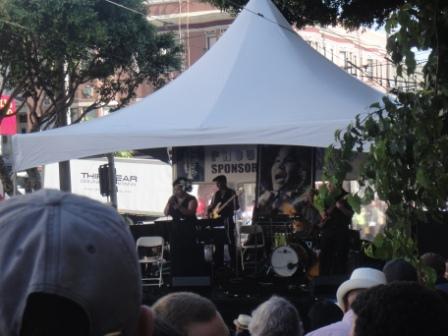
Sunday was the first day of the Fillmore Jazz Festival 2012, the largest free jazz festival on the West Coast. Your intrepid reporter made the scene along with his trusty, if slightly vertically challenged, photographer and here are the impressions.
First Impressions
Coming into the festival, what strikes you is the number of commercial and rather incongruous stalls. Do people normally come to jazz festivals to pick up Moroccan oils? I do not know. I was here for the jazz and hopefully lunch of some sort. A long hike and a tuna fish sandwich later, I found my first performance.
Wayne De La Cruz B-3 Organ band with Pamela Rose
The woman singing, Pamela Rose, was highly enthusiastic, I will give her that. The music however was that sort of ‘almost there, but not quite good enough’ level of mediocrity. With music like that, there is not much you can do but walk away. Both the vocals and the band itself were nothing really special, although of the two the band was clearly the better one. They were all enjoying themselves though, and the audience sitting there seemed to like them. As long as everyone is having fun, there is really no need to quibble. I decided to see if I could find something better for myself though.
Verdict:Neither Pamela Rose nor the Wayne De La Cruz B-3 Organ Band seem worth the effort to follow them, but if they were on the radio when every other station is playing music for teenagers who watch Miley Cyrus, then I probably wouldn’t turn them off.
Contemporary Jazz Orchestra
The Contemporary Jazz Orchestra was not just good, they were excellent. These guys had everything that you could want from a jazz band. They had a good spread of songs; some classics, including a Bird composition, and some of their own as well. They tended to focus on their solos, which were uniformly excellent. The group as a whole provided a wonderful framework in which every member had a chance to shine. For a couple of numbers, they were joined by singer Kim Nalley, who more than held her own taking the front of the stage from such talented musicians. Without a doubt, this was my favorite band of the festival.
Verdict:While not quite good enough to get you to quit your high paying job and just go around the Bay Area following them wherever they perform, this is a band that you cannot go wrong listening to. I have yet to hear their albums, but if this performance was any indication of their quality, I had better track them down immediately.
Walking Around Again
After they packed up, my photographer and I had half an hour to walk around before the next performance and observe the crowd, which was surprisingly mixed. In attendance were the expected college students and somewhat, to put it politely, absorbed older music fans, but also were a lot of people who just wanted to be out of the house for the day. There were people of every stripe there and quite a few kids of all ages. I think that whoever you may be, this was as pleasant a way to spend a Saturday afternoon as anything you could find.
Walking along, we found a group playing outside a bookstore. I do not believe that they were part of the festival, although they were certainly better than the first act I saw. They were playing well, all told, but quite slowly. Honestly the musicians seemed a little out of it. We stopped to catch a couple of songs, but walked on soon enough.
Jai Uttal and the Queen of Hearts Orchestra
On the way back to California Street, we passed by Jai Uttal and the Queen of Hearts Orchestra, who had just started. About half a song later, we walked on. There is no way that I can write anything positive about this performance. The music was just so bad that not even a whole set of girls in saris on stage could save it, pretty though they were. This was simply not good.
Verdict:It is possible that I would listen to Miley-Cyrus-obsessed teenagers’ music before this.
Kim Nalley
With that, we came to what was probably the most highly anticipated performance of the day; Kim Nalley. The set started with the band warming up before she took the stage, and their playing was wonderful by itself. Of particular note was a piano solo from Kim Nalley’s sister who later provided backing vocals as well.
When Kim Nalley herself took the stage, she started with “Damn Your Eyes”, which was quite probably the best single song of the entire festival. Her entire performance was a tribute to Etta James, who died recently, and this was a good a start as could be imagined.
The next few songs, although greatly popular with the crowd, were not ones I personally enjoyed as I am not very fond of the style. While “Damn Your Eyes” was strong and personal, the other performances were much bouncier and lighter. Every now and again though, she would throw out a number of little facts and opinions, which she would put into little melodies of their own. This was an old-school performance and, in its way, quite excellent.
Besides, whether or not you really like her music, her voice is incredible. From her songs with the Contemporary Jazz Orchestra, we knew that she was well worth revisiting and her own performance only bolstered that view. I would have preferred that she sang with more jazz and less soul, but however she sings, she does it well. Strong, powerful and teeming with emotion, her voice could make a career out of anything. You wasted your trip to Fillmore Street if you didn’t catch her.
Conclusions
This was well worth the trip on the first day. I wish that I could have attended the second as well, but the pressures of life made it impossible. Even if you don’t like jazz, there is plenty to do and the festival is very well managed. I will definitely go again next year and probably for many years after that.
So, it’s Friday night. You’re throwing the party of the year (or month, or day) at your place. You’ve bought yourself a new outfit (totally rockin’ those skinny jeans and Williamsburg-esque beanie), you’ve picked out the drinks (Pabst Blue Ribbon, what else?) and you’ve even rented a VCR from a quaint little vintage store (hey, it’s an idea). The only thing left is the bread and butter of your circle… the music. Whether or not your party will have its own hash-tag on Twitter will ride on this, you know it. You know that you can’t play the old stuff: MIA, CSS and Ratatat are a tad too trite for your taste. You also know that you can’t (God forbid) play Usher or Pitbull or LMFAO. What to do? Lucky for you, we’ve picked out five new songs that’ll get you dancing more than just the Shoegaze Shuffle.
5. “We Are Young”, by Fun.
Used in everything from a Chevrolet ad to WWE background music (!), American indie rock band Fun.’s “We Are Young” has officially broken into the mainstream, in a manner as grand as the song itself. Dramatic, marching-band drums unfold a feeble apology for the violence in a previous relationship (“I know I gave it you months ago/I know you’re trying to forget”).But, suddenly, the verse closes, the drums slow way down, and the song goes from an apologetic Bishop Allen to My Chemical Romance at a New York bar. And I’m not just talking about the video.
A slow jam/power ballad is hardly the type of music to suggest for a party soundtrack, and you might just sneer away this article at this point. But just wait until “We Are Young” hits the chorus (“Tonight, we are young/ So let’s set the world on fire, we can grow brighter than the Sun.”). Listen to how each syllable there is repeatedly enunciated and stretched and dramatized until your life somehow achieves melodramatic, Hollywood-tinted sunglasses, and you know why this song is such a cross-over hit. A better way to put it is this: everyone at your party will feel like they’re on the Gossip Girl season finale, full of drama and exhilaration and the heady rush of youth, and if that isn’t a formula for a great party, I don’t know what is.
Sidebar: We do have one bone to pick about this song. Janelle Monae possesses a divine voice that needs to be showcased (if at least for a verse), not delegated to mere backing vocals on the chorus. Ah well.
4. The House That Heaven Built, by Japandroids
You’re twenty years old: listless, restless and reckless to boot. You spend your days drinking, partying and falling in and out of lust. One such night, drunk on God-knows-what, all inhibition thrown out the window, you and your best friend find yourselves a guitar and a drum kit, and just decide to jam the buzz away, singing about drinking, partying and falling in and out of lust. If you’re thinking this is a good idea, it is: Japandroids did exactly this.
Their first album was aptly called Post-Nothing, which makes sense because the band isn’t post-rock, post-punk or whatever else. Japandroids make the kind of candid music that would require quite a bit of inebriation: and in that state, coming up with a genre for your sound would be impossibly contrived. Their second album is called Celebration Rock, and this is even more apt, for the eight songs here are just that: a celebration of rock, in all its original sex-and-drugs-and-rock-and-roll nature, before certain artists ruined it with all that hair and ego tripping.
“The House that Heaven Built” is a post-break up song (“But you’re not mine to die for anymore, so I must live”) and a lusty invitation (“We’ll shove our bodies in the heat of the night/ All day the day after, blood in the skies”), which are both interesting elements to throw into your party. But best of all, the Japandroids are insanely fun when you’re drunk, and few things are more important than that.
3. Night and Day, by Hot Chip
Hot Chip’s 2008 single “Ready for the Floor” introduced a wide audience to the UK band’s dark, clever synthpop, which makes our job easier: we don’t have to spend entire sentences convincing you to listen to their latest single! “Night and Day”, from their latest album In Our Heads, is a hybrid genre monster (electronic disco-synth dance music?) that articulates, from beginning to end, of burning lust. Hot Chip makes absolutely no bones about it. “The way I feel about you, baby, in the middle of the night/ there’s just one thing that I can do to make me feel alright,” hints Alexis Taylor; later, he loses even that much politesse: “If I could be inside you darling, at the center of your life/ I’d write no more upon the page, we’d live with no disguise,” he slyly suggests.
Hot Chip are masters of penning sexed-up versions of 60s pop songs about love. Besides, disco-derived electronica is always the perfect soundtrack for creating a ruckus. Listen to the first five seconds of this song, and you’ll know why we insist that this is an essential party song.
2. Idea of Happiness, by Van She
Electronic/pop band Van She’s record label introduced them as “new band from Sydney fresh on ideas, fresher than Flavor Flav, fresh like coriander, fresher than the Fresh Prince, fresher than fresh eggs,” and we think they’ve got it spot-on. Van She appear to be Gods of the synthesizer: they make those electronic beats pop, pound, march or roll over you, in a very seamless manner. “Idea of Happiness” is the title track and first single of their second album, which releases today. Through the haze of electronica, the track just yells one thing at you: “Screw it all, it’s summertime.” It’s like Junior Boys remixed a collaborative track by Hot Chip and Passion Pit in the Sydney summer. Or, to put it better, Van She’s “Idea of Happiness” is three things: Sydney, synthpop and summer. In fact, their entire album seems to be about those three things, and we suggest you give it a whirl after you’re done with this party. Or maybe during.
1. I Love It, by Icona Pop
Here’s what you need to know about Icona Pop: they’re Swedish, they’re “90s bitches”, they just got out of a relationship, and they are loving it. Like, seriously loving it. In fact, they’re so over you that they threw your stuff down the stairs and drove their own car off the bridge, and guess what? They don’t care. About anything. To put it into perspective, it’s like someone teleported ABBA into 2012, got them drunk, and made them party with Ke$ha. Believe it or not, that entire combination produced one of the best tracks of the year, period. LMFAO, look out.
So there you have it. Give our playlist a spin at the nearest party. And tell us what you think!
The Good Hours is a jazz album by 23-year-old singer Rachael Price, who is blessed with a voice comparable to that of the jazz greats (and uses this fact to great effect throughout this album). In fact, the first thing that will strike anyone listening to this album is how good Ms. Price’s voice is. You could place her tracks in between those of Ella Fitzgerald and Billie Holiday and they would not seem a hair out of place. Her voice is far and away the strongest thing about this album and, despite the occasional instrument solo, is all you are likely to remember.
If you doubt her vocal prowess, listen to her version of “Skylark” or “Mood Indigo” – they may as well be a capella for all the impact the band makes. She moves into Samba jazz for a single song in the middle of the album called “Lagrimas Negras”, which, although a weaker track, is quite a fun change. A dabble in Samba is all well and good, but Rachael Price is in essence a classic jazz singer who just happens to be releasing records now, and she shines most on classic jazz songs.
This album does have its share of swing though. The first track, “That Old Black Magic” starts things off well and the album keeps its bounce throughout. It has all of the energy and the simplicity of a 1920s swing record and manages to reconstruct much of the feeling those albums would bring up. However, possibly as a result of all that old-time feeling, this album does not challenge the listener, which could be a fatal flaw in a jazz record. There are exceptions, such as “The Trolley Song”, which has all of the verve of Billie Holiday singing “They Can’t Take That Away From Me”. However, the majority of the songs, while not as easy-listening as a Kenny G record, are far from cerebral.
Although this is Rachael Price’s album, the band backing her does a quite solid job throughout. There are a couple of nice solos; the vibraphone in “That Old Black Magic” or the piano in “The Trolley Song” come immediately to mind. They do not stand out, but they perform quite well and do all that could be asked from them. The piano especially frames her voice excellently, but like any frame, is a distant second to the picture itself.
“The Trolley Song”, “Skylark”, “Stairway To The Stars” and “Mood Indigo” are all exceptional performances and should be picked up if you have any love of swing jazz or just good singing. The rest of the album however is nothing really special. If you have exhausted your Fitzgerald and Lady Day collections but want more, then this is certainly worth picking up and even otherwise you will have a quite solid album on your hands, just not a very challenging one.
Verdict:The lack of challenge in the album and a number of weaker performances keep this from being a masterpiece. However, the stand-out tracks make the album worth a listen, or five.