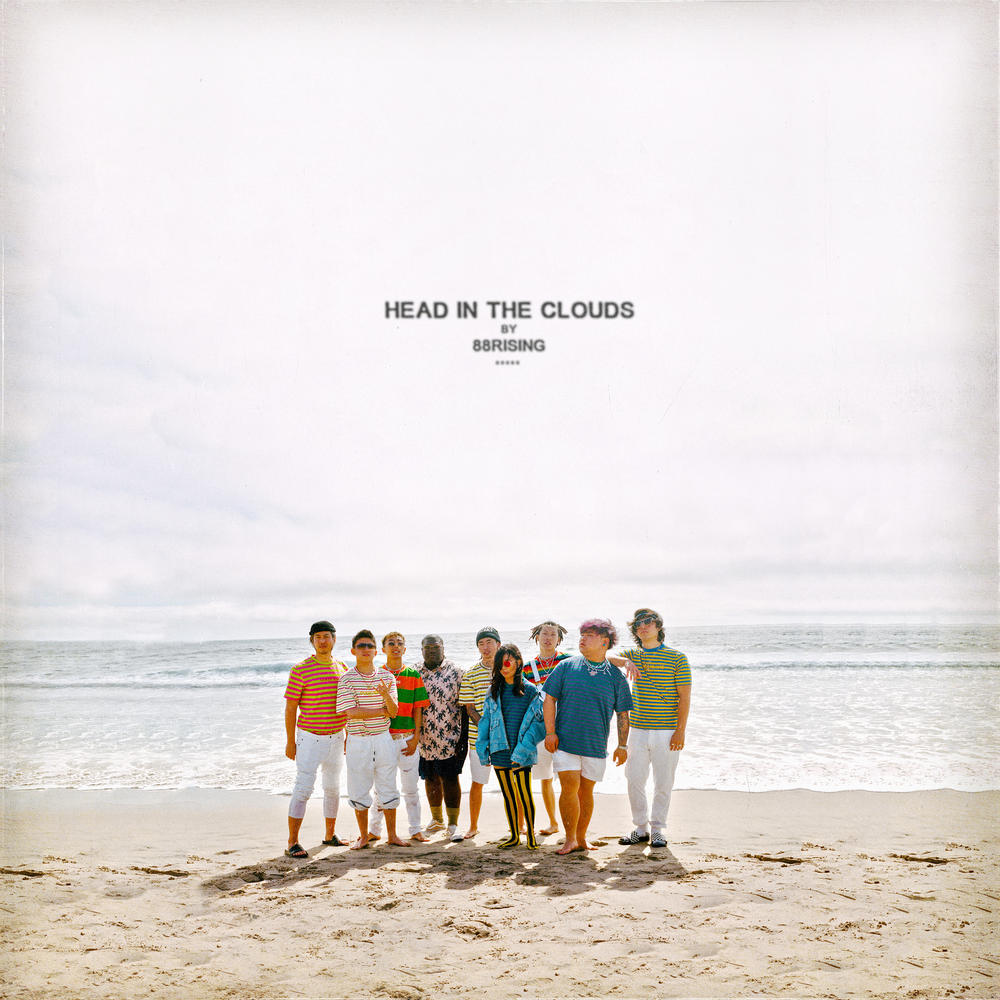
88rising is my pick for the most exciting label around right now. There’s a lot of talent in East Asia and some truly excellent music is coming out of the area. Some people have already seen some amount of crossover appeal and Head In The Clouds is a solid attempt at expanding that reach.
A good amount of the album is quite good. Most of the music with the headliners of Higher Brothers, Rich Brian and Keith Ape are quite good. “Disrespectin” is a really interesting cut with a fascinating trap / world beat, a great chorus from AUGUST 08 and excellent rapping from DZ and Maswei that mixes Chinese and English. The polylinguism is one of the coolest things about the album. Many of the artists are fully capable of smooth transitions from one language to another and it makes for quite impressive listening. Keith Ape switches both language and flow on a dime in “Japan 88”, although unfortunately the chorus and beat both drag a little too long in that song.
Unfortunately, past the main attractions, the music is largely a little weak. Some of the guests, like BlocBoy JB do nothing and I’m not into “La Cienega”. Even “Midsummer Madness” is just unlistenable due to the terribly trite chorus and beat. The rapping is solid in parts, but not solid enough to save the song and it’s actually bad in the rest.
However, much of the music is excellent. “Nothing Wrong” is solid Higher Brothers and “Lover Boy 88” is quite fun with some excellent crooning. It’s not a flawless album, but it is a very worthwhile look at some really interesting music coming from contemporary East Asia.
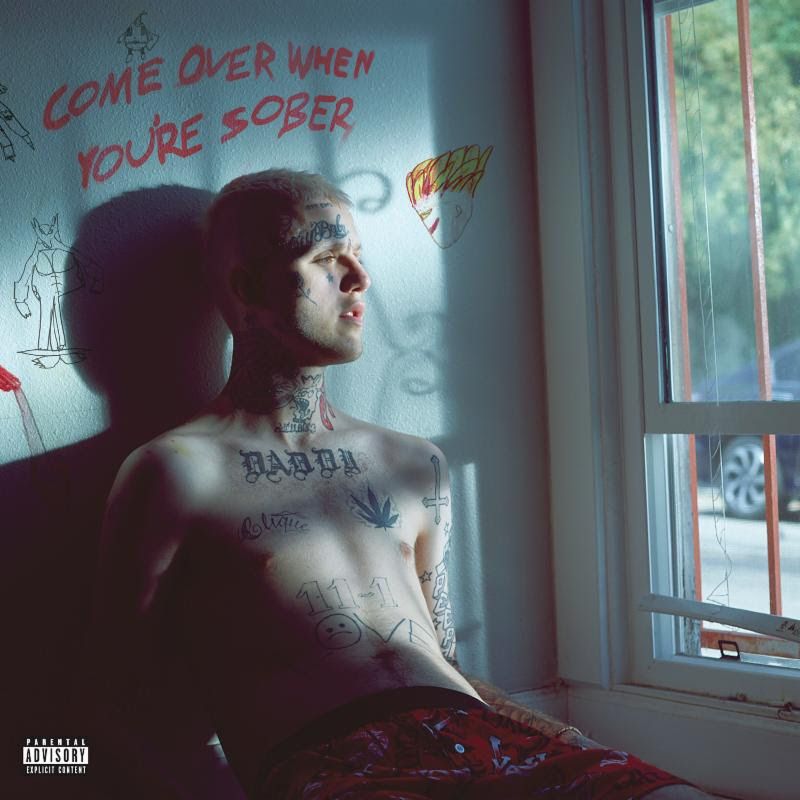
Lil Peep was the best of the emo rappers. The shape of music to come has been altered by his absence.
This posthumous album doesn’t really change or expand the legacy that Peep was able to leave behind, but it does a lot to consolidate it. Songs like “IDGAF” and “White Girl” continue the drowned, sluggish sound he broke out with and “Broken Smile” is also a standout track.
The highlight though is “Life Is Beautiful”. This might be the dark anthem for a whole generation. It is able to both be completely sincere in the titular chorus and completely honest about the pain he describes. There’s a lot more to this than the sophomoric point of finding beauty in the pain that every emo high schooler has thought original to themselves. He found the humanity in the sentiment.
This is an album that is completely open about what it feels. Lil Peep cut straight to what he was feeling and straight to your heart with the same stroke. I just wish he had more time.
Albert Hammond Jr. is perhaps best known for being the Strokes’ lead guitarist, and later for three decently-received solo albums. On his fourth album, Francis Trouble, Hammond Jr. knocks it out of the park with a record that rivals the his best output with Julian and the boys.
The story behind Francis Trouble is fascinating, and perhaps hints why Hammond’s fourth outing is, so far, his best. According to Rolling Stone, Francis was Hammond’s twin, but died in utero while Albert survived. In a way, Francis Trouble is a posthumous rendition of this long-lost, never-found twin’s personality: boisterous, spirited, and not bogged down by the baggage (positive and negative) that might plague his more-famous sibling.
In between the frenetic drums on “Muted Beatings”, we hear Francis’ hesitant but passionate claims of not caring about his lover (“Like awaitress, too good to forget”), if he had the chance to be around for that sort of thing. “Screamer”, with boastful snarks and heady solo, is practically a rambunctious theme song for the hell-raising Francis “Trouble” Hammond.
However, the best songs on here are – no surprise – the ones where Hammond meshes this newfound inspiration with his Strokes-esque sensibility of structure and rhythm. On album opener “DVSL”, he affects a punk rock scowl that Julian Casablancas would envy, over an almost trademarked perfect-fit between drums and guitars. The intro on “Tea for Two” even fits the famous Strokes formula: one guitar hits downstrokes, another guitar explores a melody, and the vocals form a third, complementary layer. He mixes it up enough, though: the bittersweet chorus reminds the listener of the Police, and the jazzy interludes are a true touch of genius.
But none of these songs come close to “Set to Attack”, a gem that falls squarely between jangly early Beatles and Room on Fire-era Strokes. Hammond alternates between old-timey verses, sung through what seems to be a 1940s radio broadcaster’s microphone,and an impossibly catchy chorus, with a signature, neat solo at the end.
What makes the Strokes so enduring is their ability to structure tight, upbeat music as a foil to Casablancas’ tone – sometimes remorseful, sometimes angry, always passionate. On Francis Trouble, Albert Hammond Jr. takes all of that and makes it much more, in a dramatic re-discovery of his enormous talent.
Best songs: “Set to Attack”, “Muted Beatings”, “Tea for Two”
In many ways, the Arctic Monkeys’ sixth studio album Tranquility Base Hotel & Casino is the antithesis of their break-out debut (Whatever People Say I Am, That’s What I’m Not).
For starters, Tranquility is much slower-paced, relying heavily on dreamy piano bits and understated bass-lines, while the debut practically rewrote the book on fast-paced guitar riffs. Lyrically, Tranquility has lead singer Alex Turner making circuitous, often self-important statements, differing vastly from the sharp observations on “From the Ritz to the Rubble” or on “A Certain Romance” – and ironically becoming the same person he lambasted on “Fake Tales of San Francisco”.
And that isn’t the biggest irony. The Monkeys’ debut propelled to instant fame partly because it was precisely at the right point in music history to become one of the Internet’s first “viral” hits – but Alex Turner, in an unfortunate turn toward the geriatric, devotes many lines on Tranquility to the supposed evils of a connected world.
It isn’t all bad news, though. “Four Out of Five”, with its bass-laden brilliance, details Turner’s fascinating album concept. Apparently, the very real Tranquility Base now houses a hotel and casino on the moon, complete with a house band (Arctic Monkeys as the Martini Police) and a taqueria on the roof. There’s also a hint of a futuristic dystopia (“Since the exodus, [the moon’s] all getting gentrified”), which the music video builds upon with intrigue.
“Batphone” is another stand-out track, with a subtly sexy bass and an old-school thriller vibe that perhaps makes the Monkeys great contenders to soundtrack the next Bond movie. The title song also shines through O’Malley’s bass-line, and a dollop of magical realism (“Jesus in the day spa / filling out the information form”). By the time you get to the chorus, you almost feel like you are, indeed, at the Monkeys’ hotel and casino complex.
However, the album betrays a steep decline in Turner’s lyrics. “Technological advances / Really bloody get me in the mood”, he complains on the title song, and seconds later beseeches his lady love, “Pull me in close on a crisp eve, baby / Kiss me underneath the moon’s side boob”. Yuck, on both counts. On “She Looks Like Fun”, he descends into simply yelling out non-sequiturs (“Good morning” / “Cheeseburger” / “Snowboarding”) – apparently, they are all references to his now-ex-girlfriend Taylor Bagley’s Instagram feed, but that knowledge cannot excuse these lyrics (and somehow makes them worse). On “Batphone”, he talks about using “the search engine” and the time he “got sucked into a hand-held device”. Perhaps the technological ignorance is meant to be quaint?
Apart from the lyrics, the album’s other big travesty is the criminal under-use of Matt Helders’ drums. Other than Turner’s (erstwhile) quick wit, Helders’ drumming was perhaps the key reason to be a Monkeys fan. On Tranquility, he is relegated to simple beats that a drum machine could have probably provided, while Turner takes front stage with an often-rambling persona. On the music front, the silver lining is that Nick O’Malley really outdid himself on the bass, practically carrying otherwise-unmemorable songs.
With Tranquility Base Hotel & Casino, the once-cool Arctic Monkeys have taken a worryingly avuncular turn. Hopefully, Alex and co. will be able to take the best parts of this album for a livelier seventh output. This one, though, is a dud.
Best songs: “Four Out of Five”, “Tranquility Base Hotel
& Casino”, “Batphone”
For an institution to survive, it must adapt. IBM doesn’t sell hardware anymore, Sony makes its money through life insurance, and the grand old genre that is Britpop looked like it was heading due The 1975. This album came in with a lot of hype as the next big thing of the once big genre and I’m not sure if it has pulled it off. As an album, it skews good if not great, but some of the songs here are nothing short of magnificent and that may be enough.
Both “TOOTIMETOOTIMETOOTIME” and “Love It If We Made It” are excellent singles with great music videos that I’m sure have already seen heavy rotation. However, the rest of the album is blameless, lacking both in major defects and in memorable qualities. It’s solid music and has some decent points, but lacks any elevating factor. It’s unfortunately tame.
The singles are very solid though. They skew hard to pop, even for a band that was already on that side of the pop-rock spectrum. “TOOTIMETOOTIMETOOTIME” is catchy and infectious and “Love It If We Made It” is anthemic and relevant. Its grab-bag of current events is blazed through at a hectic pace and its recasting of the Trump tweet on Kanye deserves awards.
There’s a few other points here that stick out. I like “Give Yourself A Try” and while I find “The Man Who Married A Robot / Love Theme” terrible, it at least fits into the album. It’s dumb and self-important and pretentious but an occasional moment like this was always the price of admission for an album like this. Something like “Surrounded By Heads and Bodies” is pleasant, but lacking in ideas, and the album lets a few too many slower songs like that in near the end. This gets to the point where “I Couldn’t Be More In Love” is bland enough to be an actual misfire.
However, the album has defined a different, more eclectic direction for the genre, even if only off the back of a couple of singles, and that’s noteworthy in itself. Now it’s on everyone else to catch up.
This is an absolute monster of an album. First of all, it goes hard. It’s actually punishing to listen to. I wouldn’t call it refreshing, but it is excellent to see an album so unwilling to compromise.
The result is something that is unquestionably unique. MUDBOY barrages you with ideas and inventions. Sheck Wes’ flow is constantly surprising and the production is endlessly clever and somehow he manages all of this genius in the most unpretentious of albums.
The other factor to this uniqueness is how much of Sheck Wes comes through on the album. It’s unquestionably him on every track. Some rappers are defined by their equivocation and by how much of their style feels like it has come from someone else. You cannot confuse a Sheck Wes song with anyone else. He even takes a moment to rap in Wolof in “Jiggy On The Shits” and there’s just so much of the real NBA in here.
On top of everything else, this is just good rap. His flow is strong, if still a little raw and, as I said before, the album just goes hard. “Mo Bamba” is a huge hit and most deservedly so. Those elongated vowels are primal in their resonance. You can’t help but respond to them and then he switches the song on you. It’s just excellent music.
This was a massively hyped debut and it delivers. This is the start of something important and you should be part of it.
Jorja Smith’s debut is the kind that has it all. She has a strong, emotive voice, a clever R&B fusion sound and an absolute stand-out single in “Blue Lights.”
There’s a little rawness in her singing and a little too much looseness in the album as a whole, but those are minor faults and only serve to make the prospect of her follow-up all the more exciting. This isn’t a singer that you need to watch out for, this is a singer that you should listen to now.
Safe In The Hands of Love is the most interesting album of 2018. It’s boldly experimental and absolutely undefinable. There are parts that could be a standard R&B track and parts that are straight rap, but then there are parts that are electronic and parts that are dream pop and a lot that is just noise and the whole set bounce off each other as though Brownian.
It actually reminds me a lot of some of the newer rap coming out. It shares something of the same 90s alt-rock roots and a song like “Noid” with its story about mistrusting 911 could have conceivably fit in any of those albums. In other places though, there’s music far too experimental for even that fringe. The distortion to break up the otherwise smooth “Licking An Orchid” is excellent, but then the unexpected bass lick is as well and the whole thing plays well against the love story too.
It is an album of tremendous variety. The opening of “Lifetime” is clear dream pop and even when the vocals shift it into something harder, the production stays dreamy. The closer “Let The Lioness In You Flow Freely” however is industrial and punishing and yet still works.
There are points that don’t do as well though. While “Economy of Freedom” is an interesting sound and compelling listen, the pace of ideas is a little too slow. These stretches of slowness show up much more often than would be ideal and are the one real complaint to be had with the album.
It is an excellent album however and well worth the time and effort it asks for. There’s a lot here to reward you for them.
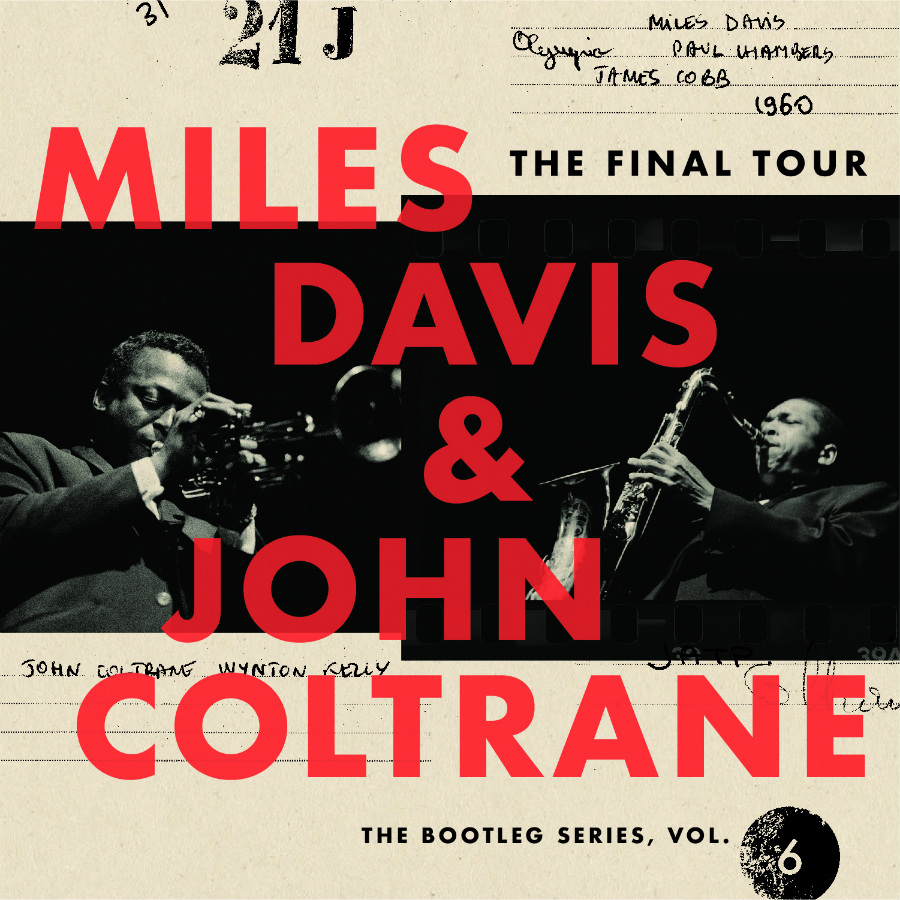
This tour came at a pivotal time for both the people named above and jazz as a whole. Miles’ magnum opus Kind of Blue was still fresh, but Coltrane had also just released his blueprint for the future, Giant Steps. Trane was already bucking to leave the first great Miles Davis quintet and further explore the new strain of jazz that he pioneered. Soon, Miles would also reinvent himself to fully incorporate this new sound, but this tour found him still firmly in the thinking of Kind of Blue and the tension between the two artists makes for a fascinating listen.
Coltrane is clearly just not in the same headspace as the rest of the quintet and his solos are fiery and bursting with ideas. You can see the early sheets of sound that would later be his calling card. His pace of new ideas is inhumanly fast and yet somehow still seems slower than he would have liked. He was accelerating into the future and it just could not come quickly enough for him.
Miles on the other hand was still in the present. His solos were much more traditional. They seem to be exactly of the style that Coltrane was trying to upend. That in no way diminishes their brilliance though. He runs a slower, purer sound than Trane, and hits the most unexpected notes and pulls them out wonderfully.
On top of that, the rest of the quintet does really great work. It wasn’t a great quintet just because of Miles Davis and John Coltrane, the whole group was amazingly talented. In particular, I really like the piano solos in Copenhagen. They’re nice and understated and yet so clever.
Seeing the contrast between Trane and the rest of the quintet is fascinating in itself. It’s almost fusion in how the two forms of jazz but highly individualistic in sound and approach.
This album would be worth the listen just for its historical value as a transitional piece, but it is also just excellent jazz from an all-time great group of musicians at the height of their powers.
This is Logic dialing himself up. It’s Logic being even more Logical than he was before. This works for him on a technical level. He has undeniable ability as a rapper, even if I find him a little unmemorable.
However, it’s also got his pretentiousness, his sophomoric philosophizing and his constant self-anointment. He’s far too self-indulgent and far too quick to give himself accolades that he has yet to justify.
More than anything though, I hate how deeply it references other rap because it does nothing more with those references than consider itself clever for making them. It’s the Ready Player One of rap. I’m sure that I didn’t get all of them, but I got more than enough to feel very, very tired.
It’s just so pointless as an album. It has almost nothing of value to say. It’s interesting to me that rap has gotten to the point where an album like this can exist, but that fact doesn’t make the album itself more interesting. It’s just not really worth your time.








 Top Five Records