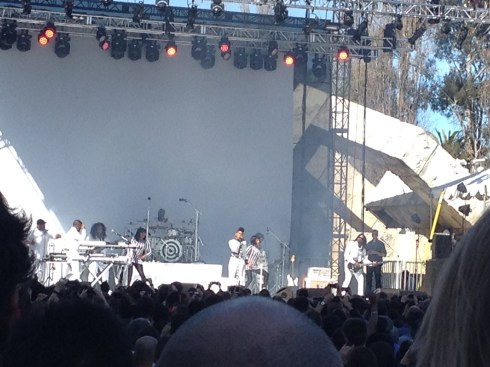
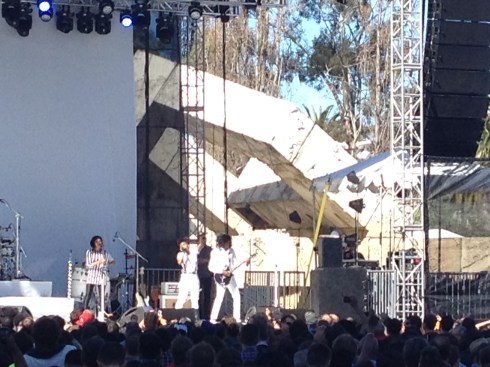
Janelle Monáe at the Justin Herman Plaza, San Francisco (7/3/2014)

10 Mar

As I have said multiple times before, I really like Janelle Monáe. She’s smart, imaginative and energetic. Her music is rarely short of excellent. Also, her live performances are incredible. So, when salesforce.com sponsored a free show of hers to celebrate their 15th anniversary and accompanying food drive, I jumped at the chance to see her live again.

This may have been a free show, but it was certainly treated like any other. It opened with an overture leading into her entrance onstage in a straightjacket to follow the Palace of the Dogs narrative that she’s spent the better part of the last decade setting up. From there, she jumped straight into a solo “Givin’ Em What They Want” that never seemed to miss Prince at all. Janelle Monáe was clearly able to supply everything anyone could need all by herself.

The show was a mixture of hits from all over her discography. “Dance Apocalyptic” led into “Sincerely, Jane” flawlessly. “Electric Lady” saw her moonwalk across the entire stage, and was followed with covers of the Jackson 5’s “I Want You Back” and “ABC”. “Q.U.E.E.N” saw her do both her own and Erykah Badu’s parts of the song, but sadly “Tightrope” did not include a stab at Big Boi’s rap. As ever, the show closed with a very extended “Come Alive” jam.

Janelle Monáe is one of my favorite people to see live. Her sincerity and enthusiasm are absolutely unparalleled. Her shows are meticulously produced and her stage presence is staggering. There are very few performers with her talent working today. She sets quite the high bar for her competition and shows like this one consistently do the impossible. They push that bar higher.

– @murthynikhil

Naturally Scattered: An Interview with Raxit Tewari

26 Feb

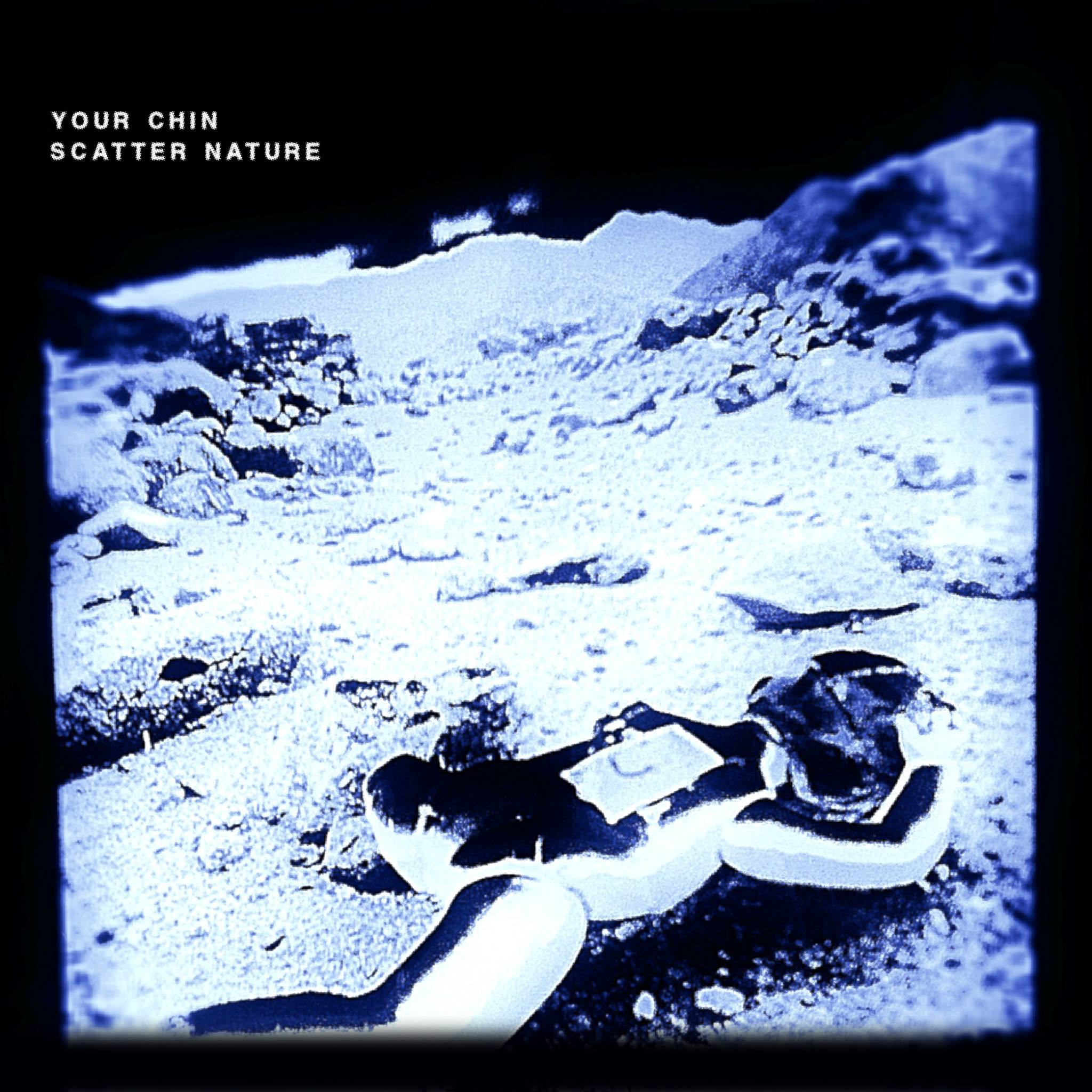
Scatter Nature

Raxit Tewari’s main band Sky Rabbit is something of an Indian indie legend. It started off as a metal band called Medusa that dropped six-track album way back in 2005, before transforming itself into the current electro-pop/indie avatar which won big at the JD Rock Awards this year.

Tewari’s solo side project Your Chin seems to have been born from the same ethos that caused Medusa’s alchemic transformation into Sky Rabbit. It may seem like effortless mood-music, but there is a solid groundwork of talent and aesthetic sense that supports it all.

Tewari describes his second EP, Scatter Nature, as soundtrack music for a solitary walk through a busy city, possibly his hometown of Mumbai. It’s pretty much a perfect summation: Scatter Nature made us think of strangers colliding and interacting like independent particles in this harried world.

“Run Along Now Little One” is the stand-out track on the EP. Tewari’s signature, peculiarly flat vocals describe arcane prophecies (“Laughing gas will burn us while we’re dodging tragedies”) over music that introspects, sighs and flows along with the pace of life. The accompanying video, directed by Misha Ghose and Naman Saraiya, is perhaps the perfect accompaniment. It syncs Raxit’s music with grungy tableaus of Mumbai life – a red telephone, a rusty lock, smoggy skylines – showcasing editor Sourya Sen’s skills as much as the directors’ or the artist’s.

This is not to say that the other three songs on Scatter Nature aren’t worth mentioning. “Fingerprints & Mugshots” is a deal less dreamy than but in a way more wholesome in sound. The phrasing of words and sentences on “Who Would Have Thought” is a character on its own. And the plaintive stretch of the titular words on “For Love”, layered over an electro-pop version of almost-dance music, is just pure magic. It’s also the closest to Sky Rabbit, in our opinion.

All in all, Scatter Nature is a great EP. It got us really excited about what we might hear from Your Chin in the future.

So excited, in fact, that we decided to hear from him now. To round off our review, here’s a short interview with none other than Raxit Tewari himself!

Photo credits: Anuj Prajapati

Photo credits: Anuj Prajapati

Top Five Records: Let’s start with something that we’re quite curious about. Why the chin, of all body parts?

Your Chin: It sucks when it walks out on you. Chewing is almost impossible. You’re left to ingesting with plastic pipes going straight into your esophagus. And that’s just one of the many things. It’s important to acknowledge and address it if you want to prevent all of this.

TFR: Artists often create solo projects to express ideas that might not fit in with other, non-solo acts. How does your musical process with Your Chin differ from how you go about making and publicizing music as a part of Sky Rabbit?

YC: Your Chin’s mostly about sitting in a room and writing/producing music with a computer. I have been tinkering with software for a while now and wanted to see if I could produce some worthwhile music like this.

TFR: Where does your music take inspiration from? Was there a particular artist or even a set of experiences that really guided you here?

YC: A lot of things really. All of them get sewn in. It keeps happening over time.

TFR: You’ve previously described your first EP as the sound of the city, presumably a seethingly busy one like Mumbai, moving along with you. What’s the right frame of mind for this one?

YC: This one’s more of a put-it-on-your-phones-and-go-for-a-walk-EP.

TFR: There’s a lot going on in your music – in terms of technique, texture and style. Tell us a little bit about your working process.

YC: I usually put down smaller ideas on impulse and then build on them at a later stage.

TFR: You recently opened for Gotye at the Oz Fest in Delhi. What was that experience like?

YC: Gotye has a terrific live act. Was an honour to open for someone who is so on top of his game.

TFR: Your style of music is not the most common type out there in India. What has the response been like, in gigs and festivals around the country?

YC: It’s been wonderful. Not underwhelming in anyway. It’s been very consistently progressive over the last few years.

TFR: We loved the music video for “Run Along Little One”, especially the beautiful, grungy montage of urban life. Tell us a little bit about the creative process that went into making this video.

YC: Thank you! Glad you loved it. We went out for a day and shot a whole lot of this place not far from home. Literally rediscovered it in so many ways. Found new nooks and corners. It was extremely impulsive and a lot of fun.

TFR: The last question we have for you is a pretty standard one. Who is the one artist, alive or dead, that you’d most like to work with?

YC: Brian Eno?

So there you have it. Listen to Scatter Nature below!

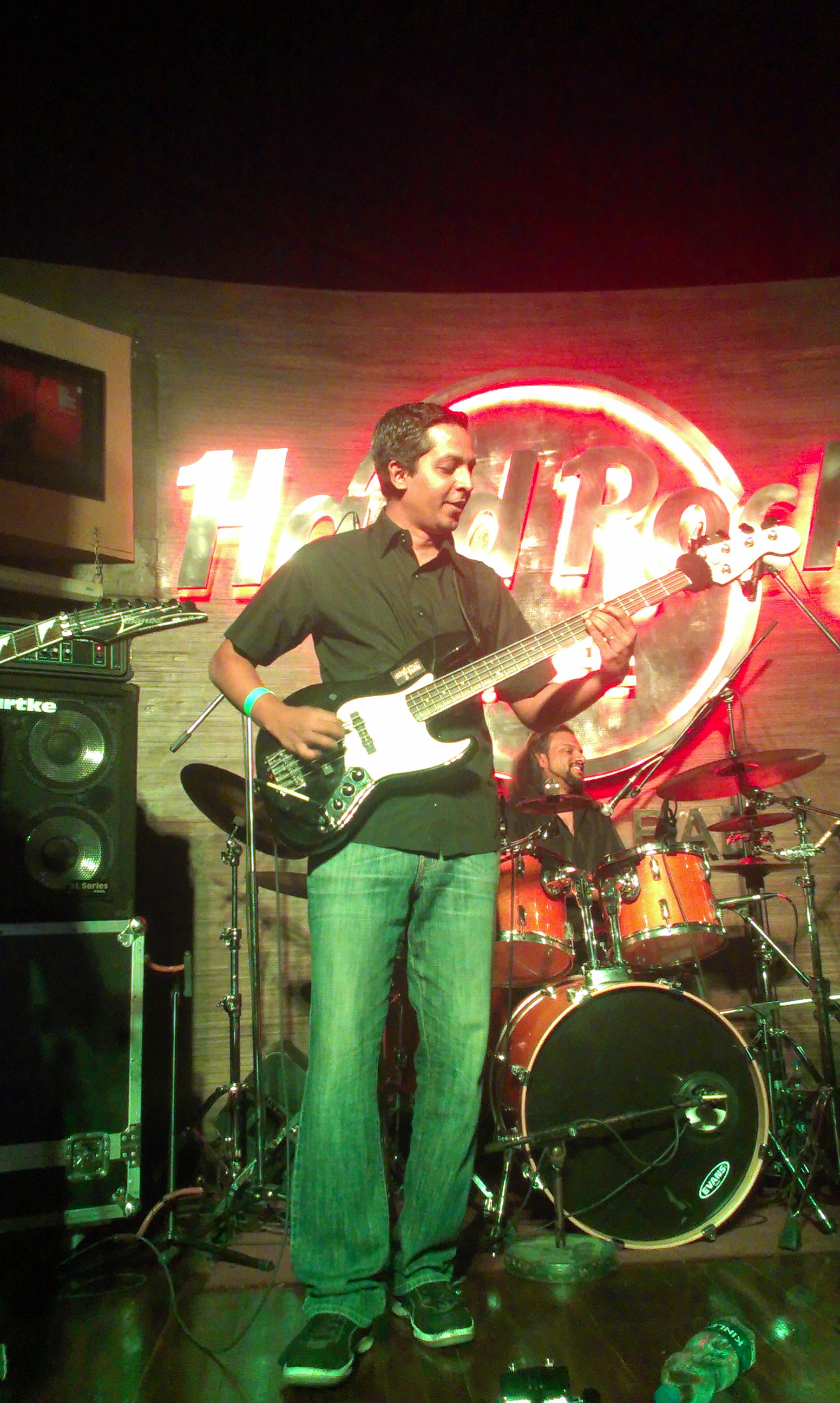
Agam at Hard Rock Cafe, Hyderabad (20/2/2014)

23 Feb

Harish Sivaramakrishnan

The Indian rock scene has, over the years, engendered numerous artists and acts – many of which have given us reason to feel proud of the music that our country produces today. From the pioneering works of Moheener Ghoraguli in the 1970s to the near-virtuosos like Baiju Dharmajan and Warren Mendonsa, Indian rock has indeed walked a long and meandering path. More importantly, they have established and re-established the fact that our musicians have often been able to step outside the mundane mediocrity of Bollywood and make refreshing music, by drawing heavily from Western rock while remaining faithful to their Indian roots.

Agam hail from Bangalore, and they call themselves a Carnatic-progressive rock band. Their music is thus a heady mix of Carnatic classical, set against an ambitious backdrop of technically challenging rock; this is not surprising, as they cite Indian Ocean, Dream Theater and Rush as their primary influences. The genesis of Agam goes back to the music club of BITS Pilani when vocalist Harish Sivaramakrishnan and drummer Ganesh Ram Nagarajan started jamming casually. They continued their shared passion after college and, after officially forming Agam, their first big breakthrough came when A R Rahman himself adjudged them winners of a band talent hunt on a Tamil TV channel. Since then, they’ve performed in gigs all over the country and have released a studio album in 2012. They have even featured in MTV’s prestigious Coke Studio in the same year.

Their recent gig at Hard Rock Cafe, Hyderabad was a wonderful demonstration of their talent – which they manage to nurture, in spite of all of them being full-time IT professionals today.

The first thing that hits you when you hear them live is the raw classical roots that Harish’s aalaps stem from. His voice reaches soaring crests and peaks, all the while remaining unflinchingly musical and melodic, reminding one that classical vocals continue to be the mainstay of any fusion band today.

But let that not downplay the inherent talents of the other members. T. Praveen Kumar’s guitar work and Ganesh’s pounding drums were also top notch, and while the keyboardist never did come into the limelight (much to my disappointment, as the keyboard forms a cornerstone of prog music, more so than the guitar), he kept the strings and the chords flowing just fine, making the overall experience wholly enjoyable. And the bassist – who was temporarily replacing their usual bassist, who couldn’t be present for the gig – did some splendid slapping on a five-string bass.

Agam

Agam performed a number of original compositions from their album The Inner Self Awakens. And much to the delight of the fans, they threw in a couple of A R Rahman covers as well – from Dil Se and Tu Hi Re. The covers were so beautifully rendered that even the most devout of Rahman or Hariharan fans would have appreciated them wholeheartedly. After nearly two long hours of beautiful music, when the show was reaching its unfortunate end, they succumbed to popular pressure and did an encore of two of their more popular songs, “Dhanashree Thillana” and “The Boat Song”, both of which were met with wild cheers from the crowd.

Most of their songs, I observed, demonstrated a high level of technical proficiency – be it with the guitar solos or the drums – and the evening reached its instrumental climax when Ganesh executed a wonderful Peart-inspired drum solo that left the entire HRC reeling. It was an absolute delight watching him wield those sticks with such dexterity; he exhibited infectious levels of enthusiasm coupled with such consummate ease that it was difficult to not admire his style of play. I also observed (given the rabid Rush fan that I am) their music is extremely inspired by Rush. A particular example is the beginning chord/drum progression in “Swans of Saraswati”, which seemed like a tribute to Rush’s iconic “YYZ”. (For the ones who are unaware, the introduction to “YYZ”, played in a time signature of 5/4, repeatedly renders “Y-Y-Z” in Morse Code using various musical arrangements, and it is one of Rush’s best known instrumental pieces.)

After the gig ended, my friend and I rushed over to meet Ganesh and Harish, and we chatted about an Alma Mater that we all shared. All in all, I enjoyed Agam thoroughly. I have heard their studio album a number of times, and while I wouldn’t blame the album per se, I must say, I liked them live far better. To the extent that, if you asked me whether I would go for another Agam gig any time soon, I would say yes. Without a second thought.

– Subhayan Mukerjee (@wrahool)

Top Five Songs to Include on a Mixtape For Your Indie Beloved

14 Feb

Trying to think of a way to introduce a Valentine’s Day-themed list article while avoiding all the common tropes (pro-Valentines, anti-Valentines, pro-anti-Valentines, etc.) is becoming harder and harder; there’s very little middle ground to walk between flower-burning and chocolate-gorging.

To try and skip over the debate, this T5R article instead provides five non-conventional songs that you ought to use when making that time-tested classic gift: the mixed-tape.

More specifically, here are 5 songs that absolutely have to go into your next mixed-tape for your present and/or future beloved; this way, you won’t have to reuse “With or Without You” for the 900th time.


5. “Absolutely Cuckoo” by The Magnetic Fields

Magnetic-fields-in-concert

The Magnetic Fields’ three-volume concept album 69 Love Songs contains exactly that: 69 love songs. Despite the fact that the album is about love songs, and not love itself, “Absolutely Cuckoo” definitely works as an unconventional inclusion on any romantic mix tape. Stephen Merritt manages to condense all the neuroticism of an early relationship into barely a minute-and-a-half, by imploring her not to fall in love with him just yet (since he might be cuckoo). In the process he admits to falling in love all the same, and also builds up the most fantastically in-depth worst case scenario of what would happen if things went south. The song’s beauty lies in the fact that we’ve all done this. We’ve all caused our what-ifs to pile up until all we can do is wallow in neuroticism. “Absolutely Cuckoo” takes this tendency and turns it around to create a song that’s so warm, well-crafted and mildly humorous that it effectively reveals the emperor’s nudity, while also providing an absolutely endearing song with which to bring you and your steady closer together.


4. “Stealing the Moonlight” by Gold Motel

GoldMotel-01-big

Gold Motel’s upbeat jangle-pop infused “Stealing the Moonlight” from their debut album Summer House perfectly articulates the emotions of the early days of a recently- re-enamored social introvert’s relationship. Greta Morgan’s aloof, unencumbered vocals combine with a bouncy set of guitars, bass and drums (provided by Chicago colleagues Eric Hehr, Dan Duszynski, Matt Minx and Adam Coldhouse)  to capture the warmth and fuzziness of early love. The wide-eyed innocence that “Stealing the Moonlight” conveys is instantly relatable (in a way which reminds me of “I Want to Hold Your Hand” by the Beatles) and works well on any mix.


3. “Hotel Yorba” by The White Stripes

WS_2007photo_3

If you can ignore the mild creepiness of Jack and Meg White’s relationship at the time, as well as the slightly off-centre music video, The White Stripe’s “Hotel Yorba” works as a pretty great love song. Against the backdrop of foot-stomping upbeat country and garage rock, Jack White allows himself time to ruminate about an almost whimsical life in the backwoods with his missus. It’s an easy song to get carried away by: the infectious optimism about the future that the song radiates is bound to transmit itself into your inamorato/inamorata, and that can never be a bad thing. Plus, brownie points for being used in the extended pilot of Arrested Development.


2. “Ghosts” by Laura Marling

Laura_Marling_3

“Ghosts” takes a rather different approach to the aspects of a new relationship, by looking at that two-tonne tether to the past, i.e. exes. Laura Marling channels the 90s café singer-songwriter in her to produce an acoustic-driven ballad that absolutely has to be shared with your main squeeze. It’s nearly impossible to enter a new relationship without carrying the emotional baggage of the past (as practically 90% of all sitcoms can testify) , and Laura gets that. “Ghosts” conveys the inner turmoil of a man as he approaches his new lover, at once admitting both his haunting by his past and her role in helping with the exorcism. This is a relationship in all its reality – not in isolation, and not under any pretension, but still hopeful.


1. “Northern Sky” by Nick Drake

Nick_Drake_(1971)

“I never felt magic crazy as this

I never saw moons knew the meaning of the sea”

Everything about Nick Drake’s world in “Northern Sky” is magical, ethereal, and beautiful. Nick’s easy-going baritone melds with piano, guitar, keyboards and bells as he invites his lover into his world through the simple gesture of telling her exactly how he feels about her.

Nick Drake’s poetry, combined with the gorgeous musical backing, makes “Northern Sky” a timeless work of art. Including it in a mix is a no-brainer.


Happy Friday and/or Valentine’s Day, from the T5R Team!

– Karthik M. (with a little inspiration from Pune).

Top Five Stunning Rock Covers to Shock and Awe

10 Feb

This is an extremely ambitious list. Not only does it try to select five out of all the good, the bad and ugly of rock covers that exist in the world, but it also tries to include a seemingly wide genre of musicians. As a result, you’ll find everything on this list: from an alternative metal band to a Spanish soprano singer, from an alt-rock super-group to a humble Indian indie band, and from a British metal icon to a classical pop pianist, all trying their level best to recreate some of the finest songs from rock music’s tumultuous past. Hope you enjoy it.

5. Tool covers Led Zeppelin’s “No Quarter”

Led Zeppelin

“No Quarter” is one of those vintage rock songs that reek of Led Zeppelin from the moment they get underway. Yes, it is bereft of any of Jimmy Page’s textbook guitar solos, and yes, it’s not the first song that comes to your mind when you think of Robert Plant either. Yet, it always comes off as a masterpiece that just couldn’t have been the work of any other band – until nearly three decades later, that is.

Tool, who lay stake to being one of the finest experimental metal bands of today, decided to cover this Led Zep classic in their 2000 album, Salival – and while doing so, they also decided to add a dash of their own progressive flavor to it.

The result is, needless to say, absolutely stunning – though, if you’re a first timer, it could take a bit of getting used to. The cover is over eleven minutes long, over four minutes longer than the original. The vocals, courtesy Maynard James Keenan, are often modulated, which may raise some conventional eyebrows.

But leaving that aside, the music is staggering. The song is dark; there’s an element of dread that runs under the thick layers of drums and heavy distortion guitar. And then there is the usual Tool innovation that rears its head now and then, be it with their rendition of the trippy riffs in the beginning or the bass and guitar arpeggios that replace the original piano.

In the end, the cover completely deviates from the original thanks to a brilliantly improvised climax full of powerful riffs, alternate lyrics, heavy bass and a thundering drum sequence that we only wish had continued for a little more.

With this cover, Tool have not only taken a page from Led Zep’s iconic yesteryears, but have also planted it amid the dreary annals of progressive metal in their own unique manner.

\

4. Tori Amos covers Nirvana’s “Smells Like Teen Spirit”

Tori Amos

To begin, let us first agree upon some things that countless others have agreed upon before. “Smells Like Teen Spirit” is the song of the early 90s, and Nevermind was probably the greatest thing to come out of Seattle since Jimi Hendrix. With these established, let us now look at Tori Amos’ cover of this cult classic.

If you were expecting a faithful rendition, one that begins with the instantly recognizable riff that grunge fans have head-banged to over the past few decades, you probably haven’t heard Tori Amos. Because in essence, Tori Amos is far – really really far – from the genre of music that Kurt Cobain pioneered. She’s a classical pianist, and she’s much older than what Kurt Cobain would have been had he been alive today. Her approach to the song is thus starkly different, and the only way you can appreciate this cover is with an open mind.

For starters, the cover is completely piano-based, and is therefore much, much slower and softer than the loud and angst-ridden original. Which means, if you’re looking for Cobain’s guitar solo, you won’t find it here. What you will find instead is a beautiful voice and some sublime, almost dreamy, piano. This is definitely not what Nirvana had in mind when they recorded this song, but the point is, it’s not meant to be what Nirvana produced either. The two versions have nothing in common except for the lyrics and the skeleton tune; trying to compare the two would be a bit like comparing pizza with cheesecake because both have cheese in them. Yes, it is the cheese that makes both of them so good, but it’s really mindless to try and choose one over the other, isn’t it?

My advice would be to listen to the cover and try to appreciate what Tori has attempted to do.

\

3. A Perfect Circle covers John Lennon’s “Imagine”

John Lennon

The original “Imagine” is a very happy song that tries to propagate happy ideas – of unity, peace and humanism. Attempting to make a dark, almost depressing cover of such a happy song does seem like a cruel thing to do – a bit like punching a rabbit in the face, and then trying to feel good about it. But the progressive-alt rock super-group A Perfect Circle had done exactly that in their 2004 album eMOTIVe. And the worst (or best?) bit is this: it is rather good.

The dark undercurrents are noticeable the moment you hear all the minor notes in the otherwise familiar piano arpeggio. John Lennon played the majors, while here, they just don’t. If anyone ever dissed about cover artists, saying that they fail to step outside the original, and that they fail to find a fresh perspective to music, he or she has probably never heard A Perfect Circle. This cover hasn’t just added a unique perspective to Lennon’s classic: it has bordered on the visionary.

The vocals (it’s the same Maynard James Keenan from Tool) continue the same sense of foreboding that the piano began. The droning rhythms of the drums and the synths supplement the vocals to create an atmosphere that sounds and feels sinister, almost ominous.

As a cover therefore, this is top class stuff. It’s quite unlike any other cover that you’ve heard. However, it doesn’t feel complete.

What seems to be lacking is lead guitars, which would have provided the final cut necessary to take this cover to the very top of this list. Apart from that, this is a must-listen – and unfortunately for all the happy rabbit fans, a must-admire.

\

2. Montserrat Caballé and Bruce Dickinson cover Queen’s “Bohemian Rhapsody”

Montserrat Caballe and Freddy Mercury

If there’s one word for attempting to cover “Bohemian Rhapsody”, it’s ‘ambitious’, and if there’s something that such ambition can lead to it, it’s generally a disaster. But when you have a Spanish operatic soprano – who’s shared the stage with Freddie Mercury in her career – embarking on such an attempt with the undisputed champion of British heavy metal, it’s difficult to not give them a chance.

The cover is eerily faithful to the original and has all the iconic elements that make the song the classic that it is. The beginning chorus has vocals in different harmonies, followed by Montserrat’s soulful voice that sends a silent shudder down your spine. Iron Maiden fans will absolutely love how Bruce Dickinson’s soaring vocals sink in to take this role. His voice reaches every high note that makes the original so remarkable, and the execution is just so perfect that it would have brought a tear to the eye of old Freddie.

As Montserrat and Bruce alternate with the lyrics, a majestic orchestra gives them accompaniment. What this means is that you won’t find Brian May’s lead guitar when you will expect it; instead you’ll find a wave of symphonic strings, peppered with the occasional piano almost throughout the length of the song. However, you can rest assured that the melodies in the cover are almost as much a treat for your ears as Queen’s original was.

Go give it a listen, and be mesmerized.

\

1. Thermal and a Quarter cover The Beatles’ “Hey Jude”

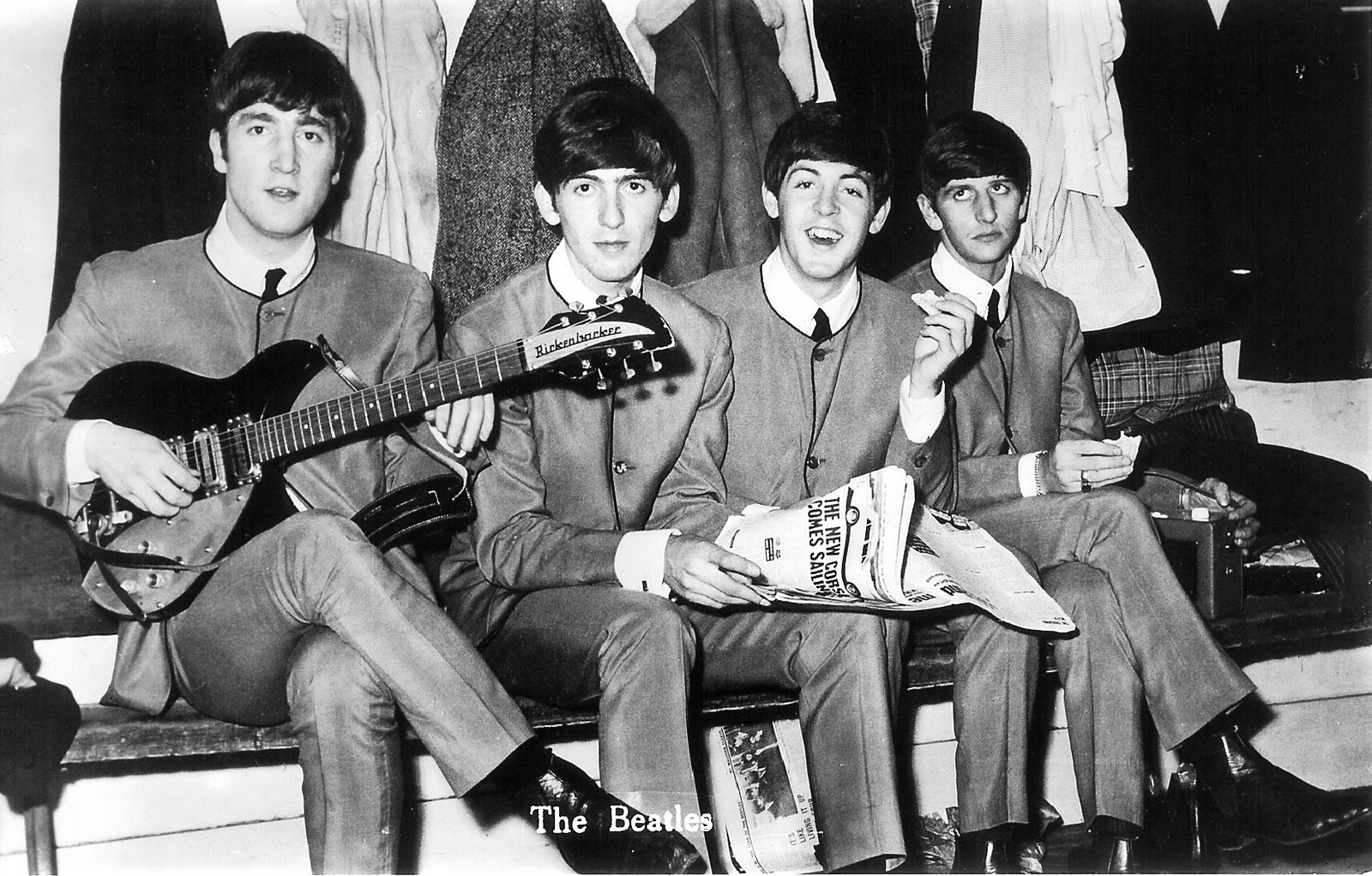
The Beatles

So far in this list we’ve discussed a wide range of covers: a darker cover of an already dark song (“No Quarter”), a seemingly antithetical cover of a loud, angry song (“Smells Like Teen Spirit”), a sad, dispiriting cover of a joyous song (“Imagine”) and an unerring cover of a particularly difficult song (“Bohemian Rhapsody”). To add to this diversity, we’ll now look at a fun cover of one of the most popular songs in rock history.

Thermal and a Quarter have been creating ripples in the Indian indie-music scene for quite a few years now. They are immensely talented and incredibly technical in their compositions, and their cover of the eye-wateringly popular Beatles classic “Hey Jude” comes as a breath of fresh air for all indie music lovers.

From the very first note, this cover stands out. It instantly catches your attention with its strange and syncopated style of play. What follows is absolute genius. The concept is terrific – a funk-blues cover of The Beatles – and the execution is spot on. Bruce Lee Mani’s vocals do complete justice to this bold attempt, as do the clever flute fillers, the pounding drums and the driving bass.

This is just masterclass stuff and thus tops this list. By far.

– @wrahool

The National: Trouble Will Find Me

3 Feb

You always know what you are going to get with a National album. As ever, Trouble Will Find Me is a technically skilled yet highly accessible alternative rock album. They remain evocative and emotional. They maintain their darkness and their humor. They are still very personal. The only issue is that their sound has also stayed constant.

It often feels that every single song by The National is the same. This is blatantly untrue, even when brought down to the scale of just this album. “Don’t Swallow The Cap”, for instance, pushes you forward with its plays while songs like “Fireproof” lounge in their melancholy. Also, quality shifts. The two aforementioned songs are excellent, while songs like “Sea of Love” and “Slipped” are fine, but instantly forgettable.

This is an album to listen to while staring out at a gray sky. Occasionally, phrases or tunes will reach your mind and draw a smile. They are after all a clever band. Lines like “I am secretly in love with everyone I grew up with” from “Demons” are too human not to relate to. However, like the rain outside, the album is too familiar and too uniform to ever interrupt your inner dialogue, and an album needs to do more to impress.

– @murthynikhil

Beyoncé: Beyoncé

21 Jan

Beyoncé, the album is Beyoncé the singer, not Beyoncé distilled or Beyoncé as an album. This is very simply Beyoncé the person. Skilled, varied, confident and astoundingly explicit, Beyoncé may not be for everyone, but she certainly rewards those who are willing to work for her.

This is an exceedingly personal album, with topics ranging from feminism to motherhood to her sex life and so you should expect your enjoyment to be tempered by who exactly you are. An identity message this strong can be alienating. However, it is rare to hear a voice as clear as Beyoncé’s and the album feels fresh in its unapologetic statement of self. Despite the freedom, the album never comes off as particularly deep but that was probably never its intention.

The music itself is highly impressive electro-R&B, even by Beyoncé’s standards. It feels clear, when listening to her, that many of her contemporaries simply do not have the voice to run half of her songs. The production is nothing novel but serves the purpose. The focus is as ever Beyoncé herself though. Even the guest spots, featuring no less than Jay-Z, Frank Ocean and Drake, firmly remain guest spots. She is at her best in the faster numbers, and the middle of the album feels mostly like filler, but the entirety is quite good.

It can be easy with this album to be distracted by the lack of hype before the album was dropped or the visual album experiment (incidentally, watching the album definitely improves it) or the debates around it. However, even when all of that fades, Beyoncé is still going to hold up as one of the career highlights of one of the few true pop superstars.

– @murthynikhil

Kid Cudi: Indicud

12 Jan

Kid Cudi is his own person. You can’t judge his third album Indicud the way you would judge other rap albums because it doesn’t feel the need to play by the same rules. Seriousness and wordplay are no part of this picture. Freshness is always a good thing though, especially when the result is something like “Red Eye”, which is essentially Haim being Haim. However, it still needs substance. His earlier songs, like the exceptional “Day ‘N’ Nite” managed to feel novel in subject matter as well, but this album doesn’t quite hold up to the same standard.

This is a very listenable album, but the sort that neither expects nor rewards deep and sustained listening. It is filled with bright spots, especially when the guests show up. The aforementioned Haim song is excellent, the RZA shows up for a monstrous anthem with “Beez” and Kendrick Lamar is, as always, remarkable on Solo Dolo Pt. 2. Kid Cudi’s production is strong throughout, bringing out the best of both his guests and himself, as shown on “Unfuckwittable.”

This is, all told, an enjoyable album. It is an album with an expiry date though. Give it a spin though. As long as you don’t expect to go anywhere, it is an enjoyable ride.

– @murthynikhil

Childish Gambino: because the internet

5 Jan

becausetheinternet

Childish Gambino’s second album because the internet is in parts brilliant. It is also in parts terrible. In that respect, it does bring to mind its namesake. It also comes with a 75 page script for a screenplay. That however, does not bring to mind its namesake. At least it wouldn’t were it not filled with emojis, internet-speak and embedded videos. You can read it here if you choose to. I did not.

Briefly, the screenplay is about “The Boy”, really Donald Glover, who lives off his wealthy father, really Rick Ross, and lives in the internet. The theme of the internet is sprinkled in impressively throughout the album. Interestingly, the sheer density of references to the immediate present give the album a slightly futuristic feel. These lyrics would not look out of place on reddit. On one hand, he sneaks ain’t nobody got time for that into a line, but on the other he makes a chant of GPOY into a chorus which, while not as bad as it seems on paper, is still pretty bad. This sort of inconsistency flows into the rest of the lyrics as well. Clever C-3PO lines and an excellent play on KKK sit next to Bangkok puns. Throwaway references to subjects like the Gaza strip don’t do much either. Still, he is the only person in rap who would make a line out of onomatopoeia.

He has all the technical skill he needs as a rapper and his production is excellent. The album comes in harder than Camp, he practically opens with the line “And I still put it down like the family dog.” He is actually quite a good singer as well, showing up well on “telegraph ave.” and the Weeknd-like “flight of the navigator.” I really like “3005” and the music video that goes with it and the entire final run from “flight of the navigator” to “life: the biggest troll.” I just don’t like having to skip past the other half of the album.

This is certainly an interesting album and it contains enough quality to deserve quite a few listens but is ultimately too unreliable to unreservedly recommend.

– @murthynikhil

The Top Five Albums of 2013: Neeharika’s List

31 Dec

As I mentioned in my Top Five Songs of 2013 list last week, 2013 has been a decent year for music. There were some great debuts, even better follow-ups and a promise for the future. So, without further ado, here’s my take on the Top Five Albums of 2013.

– Neeharika

5. Shaking the Habitual, by The Knife

Shaking the Habitual

It’s often hard to imagine what ‘textural’ means in the context of music. How can a purely tactile sense be attributed to sound? The word is often thrown about as a vague catch-all for everything from ambient to post-rock, but there is music for which ‘textural’ is a perfect adjective. One such example is The Knife’s fervent fourth album, Shaking the Habitual, which puts you in the middle of a seethingly alive jungle.

On “A Tooth For an Eye”, Karin Dreijer Andersson’s wild, unintelligible chants soar and whoop like tribal cants through her brother Olof Dreijer ‘s electronic safari through a rain-forest. The strongest beat lies on “Full of Fire”, which could form the ominous soundtrack for a dream that wakes you up sweating and disturbed.  You could get lost in the labyrinth of “Raging Lung”, gasping for breath while your masked overlords laugh at your ghastly predicament. It’s like each song comes with its own dizzying music video.

I will freely admit that I wasn’t a fan of The Knife prior to this album; their much-hyped Silent Shout came off as far too pretentious, like early Animal Collective gestated too far into the sinisterly inaccessible. However, after a few listens of Shaking the Habitual, I found myself getting enveloped in the ethereal gauze of “A Cherry on Top”, the busy techno of Networking” and the dark drama of “Wrap Your Arms Around Me”. While it’s still not the most accessible music – case in point, the 19-minute horror-movie diegetic “Old Dreams Waiting to be Realized” – there may hardly be an album in 2013 more imaginative and textural (there’s that word again) than Shaking the Habitual. Recommended, for those willing to stomach it.

Best tracks: “A Tooth For an Eye”, “Raging Lung”

4. Pure Heroine, by Lorde

Pure Heroine

Contrary to what twee stars may have you believe, being a 16-year-old famous pop star is not always easy or even fun. Even a normal teenager’s world seems to change all too rapidly; imminent rise to fame can only cause further confusion. Lorde’s Pure Heroine (full review here) is a meditation on this theme, a sort of commentary piece to the young New Zealander’s sudden rise to fame.

But sudden does not mean unexpected. In her mid-teens, Lorde possesses musical chops like none of her peers. She wields her whip-sharp pen – writing cleverly about teenage romance and suburban life and impending fame – with as much confidence as she sings, sly smirk in place. Add to that a magnetic personality – the hair! the winged mascara! – and you’ve got yourself a true pop star. The difference is that she really doesn’t want to be one. “We crave a different kind of buzz,” she explains on her hit “Royals”, before going on to claim her personal throne: “Let me be your ruler/ You can call me Queen Bee.” She fears fame, too, with the intensity of a small-town girl pushed into big-city spotlights: “How can I fuck with the fun again, when I’m known,” she wonders wistfully on “Tennis Court”. It’s quite a refreshing take on success.

Pure Heroine by Lorde – note the effect of the foisted ‘e’ in both cases – is perhaps the best debut of 2013, and one of the best albums overall. It will be interesting to see where true fame takes Lorde in her follow-up albums. She’s one to watch, for sure.

Best tracks: “Tennis Court”, “Royals”

3. Days Are Gone, by Haim

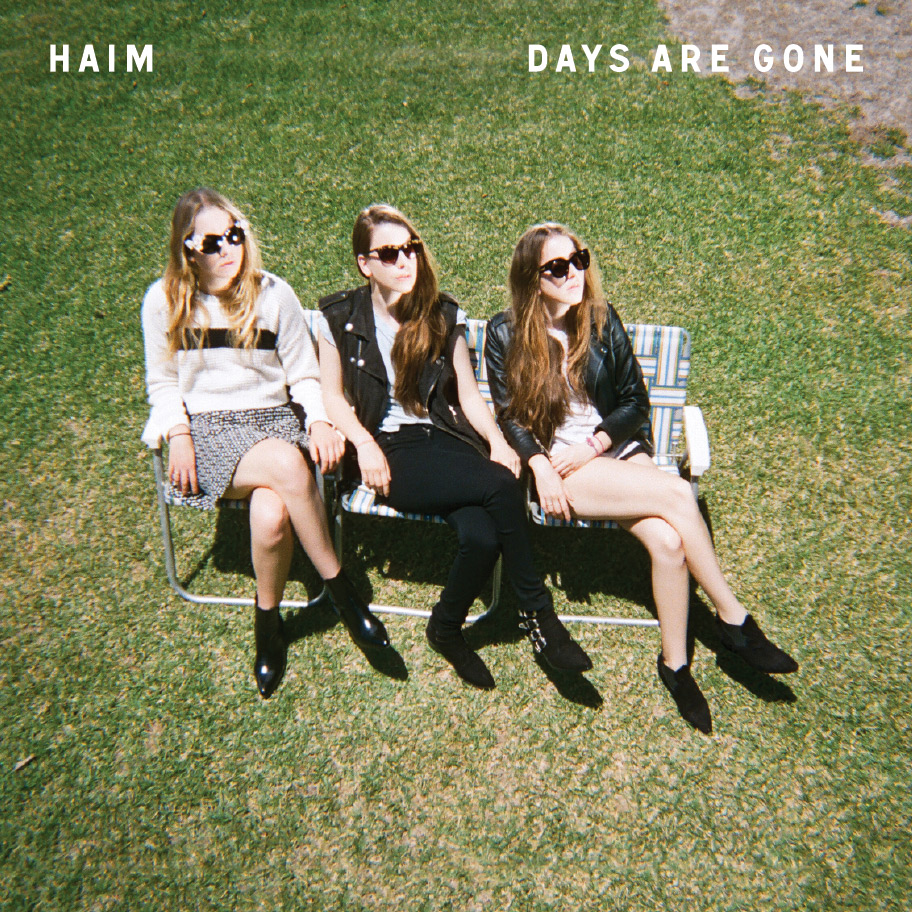
Days Are Gone

Every once in a while, a true revivalist comes along, making music that sounds like it should have been a famous hit already. On their debut Days Are Gone (full review here), Haim have managed pay perfect homage to a discography spanning synth-heavy hits from the late 70s all the way to glossy-lipped R&B from the 90s.

Haim comprises three attractive sisters – Danielle, Este and Alana Haim – whose first band was called Rockinhaim, composed of themselves and their parents. The girls make sunny, honest, genuine music that speaks of their pedigree as much as it does of their home in California’s carefree San Fernando Valley.

That Days Are Gone is a debut is a little hard to believe at times. Just listen to the sludgy-cool “My Song 5” or the shining hooks on “Honey & I”. This is music that already has a classic feel. In fact, Days Are Gone often feels like a best-of compilation of female-fronted music from pop’s golden eras, which is probably what the Haim girls intended to do.

Whether on the breezy post-breakup title song or on the irresistibly catchy “The Wire”, Danielle, Este and Alana have the confidence of old sessions regulars with nothing to prove, or world-famous musicians with several concert tours under their belts. With that sort of aura, it seems only natural that the Haim sisters are set to be superstars.

Best tracks: “The Wire”, “My Song 5”

2. AM, by Arctic Monkeys

AM

In late 2005, four young British lads released a kicker of an album about life as young British lads that immediately shot to unrivaled success. They hadn’t planned on fame: neighbors Alex Turner and Jaime Cook asked for guitars on Christmas only a few years prior so that they could play some songs together with their high school friend Matt Helders. Somehow, in an accident that involved the novelty of file-sharing, MySpace and a shamelessly salivating British music press, the boys became superstars: shy, ill-suited for fame and too wordy for their own good, but superstars nonetheless.

In 2009, Arctic Monkeys took a break from their witty chronicles of getting turned down by girls in clubs and headed to the California desert with Queens of the Stone Age front-man Josh Homme, who lent a heavy black aura to their music and lyrics. The band lost a legion of their earlier fans with the resulting album Humbug; even I, a devout fan-girl, was tempted to think that the Monkeys were losing their touch with this strange new direction. It didn’t help that the follow-up Suck It and See was lacklustre at best, with elliptical lyrics and a conspicuous lack of blistering indie rock that diverged sharply from their original image.

But now it all makes sense. Themes from their entire discography – the lusty darkness of Humbug and the way lyrics were carefully wrought on Favorite Worst Nightmare  – make an appearance on AM, which may just be their best album yet.

Every part of their act has gotten tighter. Alex has evolved as a vocalist, effecting a sly, jilted prowl on “Why’d You Only Call Me When You’re High?” as easily as the whipped desperation on “Fireside”. His lyrics, too, have gotten even better. “It’s much less picturesque without her catching the light/ The horizon tries but it’s just not as kind on the eyes,” Mr. Turner sighs about the eponymous woman on “Arabella”, going on to croon, “And her lips are like the galaxy’s edge/ And her kiss the colour of a constellation falling into place.” Quite the poet he is.

But the band is not a one-man show. On AM, Arctic Monkeys have damn near perfected the art of drawing organically from influences to create a their own new sound. Jaime Cook’s ponderous riff on “Do I Wanna Know?” evokes a stripped-down QOTSA while “Arabella” could be slipped into a Black Sabbath mixtape. The best example, though, comes on “Mad Sounds”, a beautiful ballad that fittingly brings to mind the late Lou Reed, complete with “ooh la las” sprinkled over a sparkling-pop everyman love song.

The Arctic Monkeys’ fifth album is the latest stepping stone on their journey from clever cads with guitars to mature musicians. AM is at once the culmination of everything the band has done so far as well as an exciting direction for the future. One thing’s for certain: as good as this album is, their best is yet to come.

Best tracks: “Arabella”, “Why’d You Always Call Me When You’re High?”

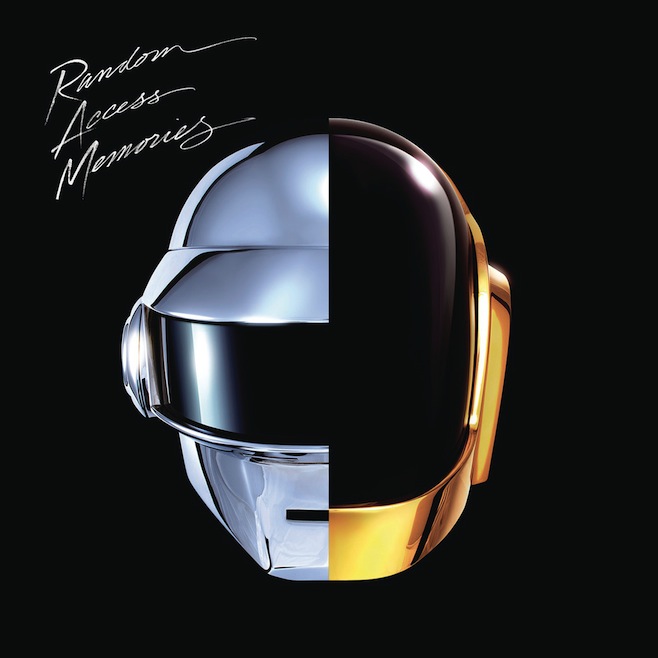
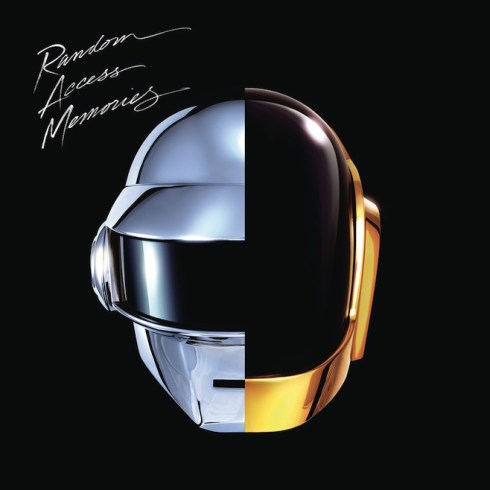
1. Random Access Memories, by Daft Punk
Random Access Memories

Putting Daft Punk’s Random Access Memories (full review here) above an Arctic Monkeys masterpiece really made me think. On one hand, I’ve been a rabid Arctic Monkeys fangirl for the past decade; on the other, Random Access Memories is otherworldly genius. In the end, timeless genius won over everything else, and that is why Random Access Memories is, in my opinion, the best album of the year.

There’s very little to say that hasn’t been said already. We can talk about the featured artists – industry legends and indie superstars alike – and how their combined starpower with Daft Punk resulted in perfect collaborations. “Doin’ It Right” sounds exactly like how an Animal Collective-tinged Daft Punk song should sound, while “Instant Crush” featuring Julian Casablancas would fit in uncannily well on the Strokes’ Comedown Machine.

We can talk about the theme – futuristic humans-turned-robots finding their way back to humanity through love and the power of music – and how perfectly every song fits into the overall idea, like robot-manufactured puzzle pieces. The story stretches from the disco heydey on song-of-the-year “Get Lucky” to the magnum opus “Touch”, which is basically a fantastic, musical version of Pixar’s Wall-E.

We can talk about the music itself, ranging from lackadaisical bliss on “Lose Yourself to Dance” to instrumental fantasia on “Motherboard”. But in the end, it’s as Giorgio says on the epic “Giorgio by Moroder”: “Once you want to free your mind about a concept of harmony and music being correct, you can do whatever you want.” This, in essence, Daft Punk’s idea for Random Access Memories.

This is not music. It’s expression: timeless and impossibly perfect.

Best tracks: “Get Lucky”, “Lose Yourself to Dance”