Sunday was the first day of the Fillmore Jazz Festival 2012, the largest free jazz festival on the West Coast. Your intrepid reporter made the scene along with his trusty, if slightly vertically challenged, photographer and here are the impressions.
First Impressions
Coming into the festival, what strikes you is the number of commercial and rather incongruous stalls. Do people normally come to jazz festivals to pick up Moroccan oils? I do not know. I was here for the jazz and hopefully lunch of some sort. A long hike and a tuna fish sandwich later, I found my first performance.
Wayne De La Cruz B-3 Organ band with Pamela Rose
The woman singing, Pamela Rose, was highly enthusiastic, I will give her that. The music however was that sort of ‘almost there, but not quite good enough’ level of mediocrity. With music like that, there is not much you can do but walk away. Both the vocals and the band itself were nothing really special, although of the two the band was clearly the better one. They were all enjoying themselves though, and the audience sitting there seemed to like them. As long as everyone is having fun, there is really no need to quibble. I decided to see if I could find something better for myself though.
Verdict: Neither Pamela Rose nor the Wayne De La Cruz B-3 Organ Band seem worth the effort to follow them, but if they were on the radio when every other station is playing music for teenagers who watch Miley Cyrus, then I probably wouldn’t turn them off.
Contemporary Jazz Orchestra

The Contemporary Jazz Orchestra was not just good, they were excellent. These guys had everything that you could want from a jazz band. They had a good spread of songs; some classics, including a Bird composition, and some of their own as well. They tended to focus on their solos, which were uniformly excellent. The group as a whole provided a wonderful framework in which every member had a chance to shine. For a couple of numbers, they were joined by singer Kim Nalley, who more than held her own taking the front of the stage from such talented musicians. Without a doubt, this was my favorite band of the festival.
Verdict: While not quite good enough to get you to quit your high paying job and just go around the Bay Area following them wherever they perform, this is a band that you cannot go wrong listening to. I have yet to hear their albums, but if this performance was any indication of their quality, I had better track them down immediately.
Walking Around Again
After they packed up, my photographer and I had half an hour to walk around before the next performance and observe the crowd, which was surprisingly mixed. In attendance were the expected college students and somewhat, to put it politely, absorbed older music fans, but also were a lot of people who just wanted to be out of the house for the day. There were people of every stripe there and quite a few kids of all ages. I think that whoever you may be, this was as pleasant a way to spend a Saturday afternoon as anything you could find.

Walking along, we found a group playing outside a bookstore. I do not believe that they were part of the festival, although they were certainly better than the first act I saw. They were playing well, all told, but quite slowly. Honestly the musicians seemed a little out of it. We stopped to catch a couple of songs, but walked on soon enough.
Jai Uttal and the Queen of Hearts Orchestra
On the way back to California Street, we passed by Jai Uttal and the Queen of Hearts Orchestra, who had just started. About half a song later, we walked on. There is no way that I can write anything positive about this performance. The music was just so bad that not even a whole set of girls in saris on stage could save it, pretty though they were. This was simply not good.
Verdict: It is possible that I would listen to Miley-Cyrus-obsessed teenagers’ music before this.
Kim Nalley

With that, we came to what was probably the most highly anticipated performance of the day; Kim Nalley. The set started with the band warming up before she took the stage, and their playing was wonderful by itself. Of particular note was a piano solo from Kim Nalley’s sister who later provided backing vocals as well.
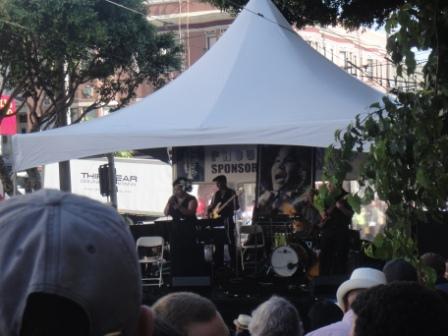
When Kim Nalley herself took the stage, she started with “Damn Your Eyes”, which was quite probably the best single song of the entire festival. Her entire performance was a tribute to Etta James, who died recently, and this was a good a start as could be imagined.
The next few songs, although greatly popular with the crowd, were not ones I personally enjoyed as I am not very fond of the style. While “Damn Your Eyes” was strong and personal, the other performances were much bouncier and lighter. Every now and again though, she would throw out a number of little facts and opinions, which she would put into little melodies of their own. This was an old-school performance and, in its way, quite excellent.
Besides, whether or not you really like her music, her voice is incredible. From her songs with the Contemporary Jazz Orchestra, we knew that she was well worth revisiting and her own performance only bolstered that view. I would have preferred that she sang with more jazz and less soul, but however she sings, she does it well. Strong, powerful and teeming with emotion, her voice could make a career out of anything. You wasted your trip to Fillmore Street if you didn’t catch her.
Conclusions
This was well worth the trip on the first day. I wish that I could have attended the second as well, but the pressures of life made it impossible. Even if you don’t like jazz, there is plenty to do and the festival is very well managed. I will definitely go again next year and probably for many years after that.


 Top Five Records