Section.80 is the work of a very talented kid. This is Kendrick Lamar’s album before good kid, m.A.A.d city and before “Control.” This is back when he was just a guy with talent and not one of the biggest names in the rap industry. The inexperience shows, there some degree of searching for who exactly he is, but there is also enough identity to make a very good, very individual album.
There are some stellar cuts on this album. “A.D.H.D.” is an excellent tale of life in the poorer parts of L.A. “No Make-Up” is a positive track in the vein of Goodie Mob. “HiiiPower” is K.Dot’s take on “So Appalled” and “Keisha’s Song” is “Brenda’s Got A Baby” and both are exceptional themselves. However, the album has its share of weak points and lacks the consistency of a more experienced rapper. His flow is a pleasure to listen to, but his lyrics have moments of weakness amongst all the cleverness.
In summary, Section.80 is a little bit rough but well worth a listen, even three years and a sequel into its history.
Perpetual Surrender is now inextricably linked to the video game Hearthstone for me. The nice thing about Hearthstone is that it is a game that you can play with whatever music you like and I have had Perpetual Surrender on hand for a while now. This is good, solid music. I could listen to this album indefinitely. I just doubt that I will remember any of it later.
This is a glossy, 80’s revivalist pop album that is fun to listen to. That statement is neither praise nor damnation, merely fact. It is the kind of album where soft saxophone solos play over synths. “Perpetual Surrender” is often intriguing. “That Feeling” is an excellent song with undeniable catchiness. Yet, for all of the album’s many strengths, it is a little too bland to truly champion.
This album is a person at a party, a person who is dressed nicely and seems to have everything together. A person with whom you have an interesting chat and share some laughs. A person with whom you enjoy the time you spend. At some point though, you have to leave the party and you leave unchanged. I needed something more.
It’s been quite some time since 1992 when a young Snoop Doggy Dogg stepped into the game on Dr. Dre’s The Chronic. A lot has happened since then, including the death of 2Pac, some experiments with reggae and a Call of Duty voice pack, but Snoop is still one of the giants of hip-hop and a fine man to see live.
Snoop is also a man with an unquestioned ability to have fun. This was not so much a concert as party time with Uncle Snoop. In the middle of the concert, he played Joan Jett’s “I Love Rock ‘n’ Roll” and just chanted the chorus with the crowd. His charisma is undeniable and his happiness was clearly genuine and very infectious. I don’t think it is possible to go to a Snoop Dogg concert and not have fun.
This playfulness resulted in a far more eclectic show than I expected. Not only did a Joan Jett song make an appearance, but also Kriss Kross’s “Jump”, and even The Notorious B.I.G.’s “Hypnotize”. Of course, he followed that with the west coast classic “2 Of Americaz Most Wanted”, sadly without the associated 2Pac hologram.
He dropped classics from all across his career over the show. From “Lodi Dodi” and “Gin & Juice” from his debut album Doggystyle to “P.I.M.P” and “Drop It Like It’s Hot” to as recent a song as “Hit Da Pavement” from 7 Days of Funk. His has been a long and storied career and we were treated to the entirety of it.
Uncle Snoop took us out for one of the most fun nights that I’ve ever had. No one can make rap look as easy as he does.
As we previously mentioned, we were very impressed with electronica/ambient/post-rock band Until We Last’s recent performance at Counter Culture. New writer Anindita Nayak recently got a chance to speak to Ketan Bahirat, founder of Until We Last, about the band, his early start in music and challenges.
Photo courtesy Until We Last’s Facebook page.
Let’s talk a little about their music first. Until We Last songs transport your mind to different level with their unusual mix of melodies, making them sound a little like God is an Astronaut or Explosions in the Sky (though the band does dislike the comparisons sometimes). One of our favorite songs of theirs is “Water”, which sounds even better live than it does on the album. Unfortunately, their SoundCloud channel doesn’t have all of the songs they had performed at CounterCulture, but maybe we’ll find them on their upcoming EP, which is launching in a month’s time. Now, let’s move on to Until We Last’s journey.
Currently in his penultimate year of college, Ketan Bahirat took formal Hindustani lessons back in 6th grade. He picked up guitar skills from YouTube videos and played with two metal bands before forming Until We Last in 2011. Until We Last has been performing live since late 2012, culminating in the launch of an album, copies of which they were more than happy to give away free at Counter Culture. When quizzed about his personal favorite gig so far, Ketan speedily answers with Magnetic Fields, an impressive festival in the middle of the Rajasthani desert.
The name of the band stems from a philosophical note that revolves around travel, our home planet, nature and the quest to strike the perfect balance between sustainability and development. When it comes to song names, it’s usually based on circumstances. Their most popular song, “Rain”, was so named because it was raining when they were composing it! And there is, of course, a conscious decision of keeping a close reference to nature or travel.
The initial few compositions were recorded in Ketan’s bedroom. When looking for potential band members, he remained close to the local music artists and often jammed with them. It hasn’t been an easy ride for Until We Last, considering that the lineup has had over ten changes so far. The longest time without a lineup change was for a year, ending when the bassist, Anjan Bhojaraj, left for higher studies and was replaced by Paul Dharamraj, a former member of the Bicycle Days. This aspect is probably one of the major challenges for any band, especially when the band members are so young and other aspects will tend to take higher priorities.
However, working with so many artists has also helped Until We Last’s music evolve. One of their former band members, Bhargav, continues to send across pieces of compositions from Singapore and they are continuing to reach out to other artists who could collaborate with them to produce more music.
Photo courtesy Until We Last’s Facebook page.
One good thing that struck us about Until We Last is that they don’t seem very concerned about the prevalent culture of piracy, especially in a country like ours. Admittedly, the growing number of music festivals and venues is changing that culture in India, but the fact remains that platforms for indie artists to sell music are uncommon and finding people who are willing to buy music is even less common. Until We Last has also seen a good amount of traction from countries like Germany and Russia, where listeners are willing to pay for their music.
But in the end it’s all about sustainability: fans need to buy music to support good artists. On that note, please do listen to Until We Last’s music and maybe buy it too. And be sure to follow their updates on Facebook and Twitter too. We wish them all the success with their upcoming album!
UPDATE: After a massive 3 and a half hours of playing and talking about his life, his work, and a hundred other things, Siddhartha Khosla’s gig is over. But thanks to the magic of Internet, you can still watch the concert online at the link provided below!
Whenever someone questions how I’m able to fall in love with and obsess about something as abstract as music, I toss them a Goldspot song; it tends to shut them up quite quickly.
Goldspot has remained a critical darling since their public introduction by New York’s DJ Nic Hardcourt in 2005; since then, their music has featured in countess “Top Ten” lists. Siddhartha Khosla and his constantly-changing line-up of musicians have done everything from touring India and the US to singing at the White House Diwali celebrations to crooning to a flock of geese, and won countless hearts at their live shows on both sides of the Atlantic.
Siddhartha Khosla’s ability to mine his past to use as an influence for his current music endeavours makes his music incredibly relevant and accessible to a wide audience. His lyrics speak of the positives and the negatives of his life, and translate them in a way that makes them relatable to his listeners. It’s the sort of work that reminds you why music is considered art.
It’s been 2 years since Goldspot last came to India, and though it may be a while yet before they’re back in corporeal form, Siddhartha is bringing us the next best thing:
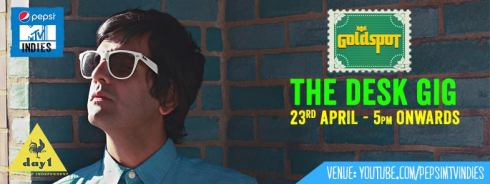
At approximately 5 PM Indian time (GMT + 5:30) today (23rd April, 2014) Siddhartha will be playing a live gig from his desk, to be broadcast live thanks to Pepsi MTV Indies. Siddhartha’s charisma and talent makes for a compelling argument as to why you should tune in, but in case you need reminding, we’ve provided 5 more songs to showcase why you need to watch this gig:
If The Hudson Overflows
“What’s the use in worrying about the ways in which the world might come to an end? When all along, there’s been a book on the side of the bed that you’ve never read instead?”
“If The Hudson Overflows” was featured on Season 8 of CBS’ How I Met Your Mother in what I would argue is the single best musical moment on the show (rivaled possibly only by Season 5’s “Rewind,” again by Goldspot).
The song has a simple, clear message: Don’t worry and don’t wait. The way this message is presented, however, is anything but that.
Over the course of four minutes, Siddhartha Khosla’s time-displaced, reassuring voice sends us on a beautiful journey to bring us face to face with our own mortality; upon doing so, however, he calmly reassures us that everything’s going to be okay, and for these four minutes it’s almost believable.
Backed by a barely-noticeable repetitive harmonium, softly picked guitars and a constantly present booming percussive drum that hides within itself, “If The Hudson Overflows” is perfect for those late night moments of panic about where life is heading.
“If the Hudson Overflows” was also downloadable as a single on iTunes with all proceeds going to help in the post-Hurricane Sandy reconstruction and rehabilitation efforts, because Goldspot is just that wonderfully nice a band.
2. The Border Line
It’s hard to pick which aspect of “The Border Line” is more appealing: the song itself, or the accompanying video. “The Border Line,” another song off Aerogramme, follows the theme of most of the other songs in the album in talking about the dichotomy of being born in one place and raised in another, and the mix-and-match of cultures that this results in. Siddhartha Khosla’s sense of being split down the middle comes through strongly in the song:
“Atoms escape in the middle of the night when my heart and head collide.”
All of this is done against a jangly, foot-stomping, hand-clapping rhythm and melody that takes the best of modern indie sensibilities and steeps it in ‘60s pop from both the East and West, making a musical tea that leaves you warm and glowing hours after the last foot-stomps fade away. The Border Line works brilliantly as a song, but works even better when heard while watching the gorgeous, gorgeous video by long-time collaborator Nick Collett. The video features a montage of clips of people from all over the world engaged in that common unifying factor: dance. Nick Collett’s video brings people together across time and distance with a sincerity and earnestness that no Coca Cola advertisement could. Also watch out for the interspersed shots of Khosla jamming while channeling his finest ‘60s Rajesh Khanna!
3. Foundations
“I hear there’s a wind that takes these plans and runs, but don’t worry; don’t worry, we’ll make new ones.”
Goldspot is often compared to the Beatles for their musical sensibilities and their ability to elevate what should be a straightforward pop song into something that is sublime and deep.
It’s not a talent that’s held by a lot of people, and it’s what makes listening to Siddhartha Khosla’s live sets so enriching: his ability to strip down, layer, mix, chop up and altogether rework the basic elements of his music in countless different ways and still present something fresh and attractive.
“Foundation,” which was written for the indie film Today’s Special, continues the jangle-pop mélange of styles and sounds that Goldspot espouses, only this time in the form of a love song. Siddhartha Khosla captures your heart with both his voice and his bouzouki, backed by a full and rich mix of rattling drums and guitars.
And continuing in his tradition of being an all-around stand-up guy watch this video of Siddhartha and his bouzouki singing for Aidan, a young boy with cancer:
4. Emily
Goldspot’s second album, And the Elephant is Dancing deals with some very complex and sometimes dark themes in the guise of sugar-coated indie pop, and “Emily” is a great example of this.
Lurking beneath the surface of the song, which features the same ever-present booming-drum backbone found in “If The Hudson Overflows” mixed with classic RD Burman string flourishes and a magically velvet keyboard, lies a story of profound loss. It’s impossible not to empathize with the protagonist’s attempts to reconnect with his lost love:
“See, I tried to kiss you through the pillow on my right; and oh, Emily, will you marry me again?”
5. Friday
“Friday” represents the perfect case for the argument that Goldspot is what the Beatles would sound like today. Despite being more than 8 years old now, “Friday” is as timeless and fresh as it was in 2005. It was played in heavy rotation both in India and in the US back then, and deserves to have the same attention now.
The song starts with swishy strings straight from ‘70s Bollywood that segues into a catchy rhythm guitar that is altogether transformed by Khosla’s voice. “Friday” is straightforward, but earnest; simple but sincere. It’s impossible not to like it, because it does absolutely everything right. The conviction and clarity with which Khosla implores “give me a sign” is unrivalled, and the Kishore Kumar strings that reappear during the breakdown and in the outro is goosebump-inducing, for all the right reasons.
“Friday” also comes in a Hindi acoustic version sung to a rapt audience of ducks and geese in Regents Park, because sometimes life really is just that awesome:
Take a break from exams. Skip a class. Sneak in a break from work (or better yet, call your boss over! They may give you a raise in the process). Grab a friend, a lover, a loved one, a pet. Watch this gig! And maybe make some noise online to try and get Siddhartha and co. to come back to India soon!
They are a very easy band to like. They’re fun, they’re immensely talented, they make very good music and after this concert, you can add excellent live to that list.
Shy Girls
The opening act Shy Girls were mostly good, but a little inconsistent. Their first couple of songs were enjoyable, but the ones that followed were honestly a little boring. All told, they provided an enjoyable backdrop to the crowd’s conversations, but never really managed to shift the focus to the stage. They were a little too self-indulgent to be truly interesting, especially when their performance moved further into the emotional. I do appreciate a band that pulls out a soprano saxophone though, even if it is mostly for pop appeal.
Haim
It is easy to underestimate just how talented and versatile a band Haim is. Their opening songs turned the vocals down and the guitars up for some hard rock including an extended jam of Fleetwood Mac’s “Oh Well“. They possess a tremendous amount of technical skill and were perfectly at ease shredding to start the show.
From there though, the concert broke into a more melodic set. Their ballads were excellent live. Both “Honey & I” and “Running If You Call My Name” were outstanding. Additionally, “My Song 5” could have started a mosh pit. There was not a single weak performance in the entire set.
Unsurprisingly, their stage presence was also incredible. Este’s bassfaces were everything they were promised to be, Alana was exactly the cute youngest sister that her twitter account @babyhaim would lead you to believe and Danielle appeared to channel Jimi Hendrix in her guitar solos. This was not only a great concert to see, this was fun as well.
For their encore, they brought out their parents to perform a song from their Rockinhaim days, a funky number called “Mustang Sally.” They followed that with “The Wire”, the one hit that the main performance missed and ended with everyone on the drums.
This was exactly what a great concert should be. There was no flash, there were no gimmicks, there was just good music and a fun band. This was a joy to watch.
We have already expressed our deep and undying love for Saturday mornings soundtracked to new music, so here’s a companion piece to that. This list is about those magical hours of optimism on a Sunday morning, right after a Saturday night party and right before the weekend rapidly fades away. And what better way to make the feeling last than with five fresh new songs? So, without further ado, here’s our suggestions for a soundtrack to your feel-good Sunday morning. And we promise it’ll only take 22 minutes and 6 seconds of your life to listen through it. Go on, then.
“Alley Cats” by Madboy/Mink
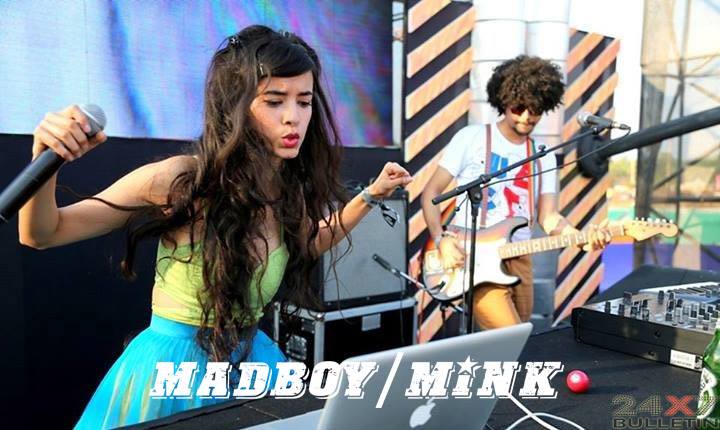
Madboy/Mink is a jazz-dance outfit from Bombay that has been blowing our minds since their debut EP All Ball dropped on SoundCloud last week. The group comprises the young and talented pair of Saba Azad (“Mink”) and Imaad Shah (“Madboy”). Azad has the perfect voice for electro funk/jazz: velvety, eccentric and deliciously retro at the same time. She’s worked with the legendary Blackstratblues before (source: Rolling Stone), and she seem to carry along that band’s nonchalant sense of joy in music with her. Shah has already created quite a following for himself as Madboy, courtesy a raw talent for musical arrangement (see: “Martinis in the dark”). He’s also otherwise known for being Naseeruddin Shah’s son (!).
Azad and Shah.
“Alley Cats” is about snazzy, bowling cats with snazzy bowler hats, and the fun doesn’t stop there. The duo tells the silliest tale – of fish-stealing, rat-chasing cool cats – with such verve that you just can’t help feeling great just listening to the track. Madboy/Mink boasts at the end of the song, “Yes, this band is pretty tight/We’re the kings and they’re the rats,” and they may really be onto something there.
“Dont Stop” by Tankbund
The first minute of “Dont Stop” features lead singer Ritwik De vocalizing what could be the soundtrack to someone’s unsaid feelings on a rainy, lonely Saturday evening. His gauzy, warm voice lulls you into a false sense of introspection, so that when the song suddenly breaks into six-beats-a-second, you tend to feel just a touch of disorientation. De’s soulful, deep voice syncs perfectly with the stop-start, almost trip-hop electronica in the background. His plaintive request (“No, don’t stop”), stretched over several heartwrenching seconds, is persuasive, emotive and entirely lovely. If you loved this track, be sure to check out “Tres Bien”, also from their debut EP Inside. We’re definitely listening to more of this New Delhi band.
“Good to You feat. Siddharth Basrur” by Sandunes
Sandunes, aka Sanaya Ardeshir, is one of the most intriguing artists in the country. Her music is an eclectic confluence of influences: there’s a lot of Air and Zero 7 in there, with playful hint of old-school jazz thrown in for good measure. “Good to You”, featuring Goddess Gagged lead singer Siddharth Basrur, seems to be a post-break-up ode of promises and thinly-veiled remorse, backed by Ardeshir’s top-class production sensibilities.
Sanaya Ardeshir
“Good to You” breaks and crests and pulses at exactly the right places for exactly the right amount of time. There’s a point in the song, about two and a half minutes in, when Basrur’s repeated “I’ll be good to you” precisely syncs with splashes of woozy electronica, that especially blew our minds. Listen to it on a Sunday morning, and we promise it’ll leave you feeling chill the whole day. What more could you want?
“Fire” by Machli
Bangalore-based electro-acoustic outfit Machli is made up of design students who, true to stereotype, have an uncanny sense of aesthetics. “Fire” is a lush, ambient tapestry carried by Sandhya Visvanathan’s despondent, lilting voice and Aniruddh Shivakumar Menon’s percussive talents. The song is addictive and just perfect for half-sleepy Sunday mornings. Also check out their ‘Tigerbalm Mix’ (found here) for a more dreamlike, trip-hop take on the song.
“Epileptic” by 30ton Capacity
Bangalore has seen its fair share of talented post-rock bands lately: Space Behind the Yellow Room and Until We Last come to mind. With their debut EP Season One Episode Nil (you know, like S1E00 like at the beginning of a series), post-rock-veering-on-prog band 30ton Capacity joins the growing list. Our favorite track from the EP is “Epileptic”. The track starts with a quirky, Radiohead-like spoken-word sample (“Try to relax your toes, Gloria. Feel them tingle. Relax them one by one…”) that immediately sets the young band apart. Robin Srivastava’s shrouded vocals create a beautiful, delicate wall (curtain?) of sound, complemented ably by drummer Sumanth. We’ll definitely be listening to this band a lot more!
—
Here’s the full playlist for your easy listening pleasure.
Speedy Ortiz’s debut album released just about half a year ago, and we loved it, as did many others. Their latest EP, Real Hair continues their style of lo-fi 90’s inspired alternative rock and their trend of making amazing music.
This album is wish fulfillment of everyday dreams. “Shine Theory” speaks of leaving neighbors scary notes while they’re away at work. That’s the first step. That’s a throwaway dream. A common, fondly held kind of dream, but still to be discarded in a moment as is, quite correctly, that lyric. This is the setting, this is how you begin to understand that she is you and that I am you and that none of us are very nice. Still, I have dreams and you have dreams and she has dreams and this album is the satisfaction of them all.
Like its predecessor, Real Hair is a love letter to the early 90’s. Pavement and Dinosaur Jr. are unabashedly drawn from, but form a support, not a straightjacket. “Oxygal” for instance makes creative use of form to create a sound that would be dissonant were Speedy Ortiz not so good at their music. The guitars are excellent and Sadie Dupuis’ vocals amaze. The music itself is rough, defying the shininess endemic to modern alternative rock and leaving in its stead an honest commitment to the sound. Hero worship is a desire, not to be the person worshiped, but to have accomplished what that person has done. Speedy Ortiz here have written the perfect kind of love letter, a letter from one peer to another.
The lyrics cover standards of everyman life. Self-loathing and toxic relationships have never been far from the indie songwriter’s pen, but Sadie Dupuis is brutally honest and human as she goes over them. Additionally, the lyrics are nothing short of poetic. Self-deception and raw desires and all of the pettiness and glories of personal lives are mixed in the whirlwind that is this EP. Every time that you have felt hurt and trapped not only by the world, but by yourself, and was unable to communicate even to yourself why you hurt and just wished you could talk so that maybe you could begin to understand, Real Hair is the fulfillment of those wishes.
Real Hair is a wonderful four songs, and I highly recommend that you listen to it.If you’ve ever wished for another 90’s alternative rock album with excellent music and whip-smart lyrics, it turns out that Real Hair can satisfy that wish as well.
Chick Corea is one of the few giants still left in jazz, and The Vigil shows no signs of him slowing down. It’s been quite a while since his time on In A Silent Way or Bitches’ Brew or his time with Return to Forever, but even at 72, he can still put out an exceptional jazz album.
The Vigil is his first recorded album with his new group after years of performing live together, and their time together shows. Intricate solos intertwine effortlessly, especially in the live “Hot House”. The music remains clever after many listens and manages to maintain that intelligence over an eclectic and varied track list. Fusion, modal and Latin and Spanish tinged jazz all find their place and mesh excellently over the course of the album. The entire album benefits greatly from the touches of Spain. “Pledge For Peace” in particular is very Olé Coltrane-esque.
A few missteps keep this from truly being a masterpiece. The vocals in Outside of Space mar an otherwise excellent song and the album is a touch predictable in places. Nevertheless, this is an excellent jazz album and showcases a highly talented group from whom I hope more is soon to come.
The month of March was a great time to visit Counter Culture, an excellent, aesthetic live music venue in the bustling Bangalore suburb of Whitefield. March 8 fielded an eclectic and wholly excellent bevy of women artists in honor of Women’s Day; this weekend features Avial, Agam and Lagori in a delicious palette of modern Indian music. But last weekend was truly the centerpiece of the whole mad March extravaganza: five gifted, exciting bands that form a rough outline of where Indian indie is today and where it has the potential to go.
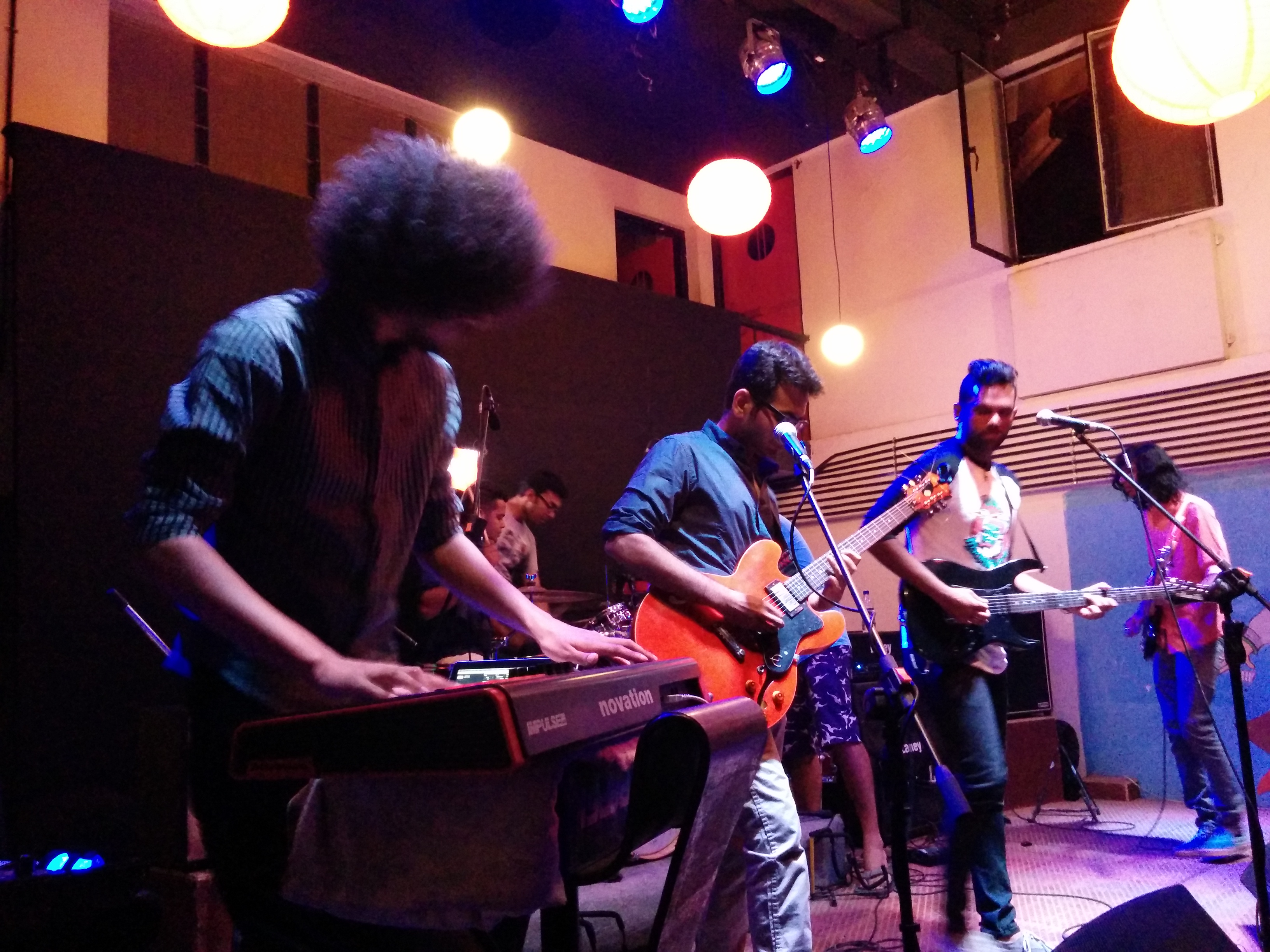
First on the billing at the Indie March night on March 22nd was the intriguingly-named post-rock Bangalore act Space Behind the Yellow Room. This was the first time I’d heard them, and the little that I did hear that night was magical: the ethereal, frenetic music setting the tone for the night that was just unfolding. Interspersed throughout their mostly instrumental pieces were some rather unfathomable, but wholly enjoyable shrieks and screams from the drummer (we’ll never know if they were parts of the composition, or in-situ improvisation). Unfortunately, due to a number of reasons including Bangalore traffic and unfashionable lateness, I only managed to catch a few snippets of their music, but it definitely made a great first impression. And raised questions, too: what is behind the yellow room?
Which space? Why yellow?
Space Behind the Yellow Room was followed by Until We Last, another post-rock band from Bangalore. From what I could gather, there were two different impressions that people had about Until We Last following Space Behind the Yellow Room. Some, like myself, thought it wasn’t the smartest of lineups: post-rock is great for quiet introspection and expensive headphones, but by this time, most people had had a drink or three in them and wanted, well, dance music.
They were dancing, but in a more post-rock way.
Others disagreed. Another Top Five member found the band to be top-notch, and arguably one of the centerpieces of the music that evening. Either way, though, Until We Last definitely did not disappoint. I had first seen them at the Bangalore Weekender last year, where they completely transformed a lawn on a bright Bangalore morning into a dreamlike, almost ethereal space. Here, too, they brought the same ethos, but perhaps their music is more suited for the aforementioned bright mornings: a few hundred tipsy twenty-somethings aren’t the best vessels of contemplation. Special note must be given, though, to their track “Water” as well as the way they signed off: “We are Until We Last.” Think about it. It’s pretty deep.
Like I said, two post-rock bands back-to-back wasn’t the greatest of ideas. In essence, the atmospheric drama carefully draped over the crowd by these two bands was ripped apart the second the F16s took to the stage. The young Chennai indie rock band were coming off of strong wins at IIT Madras, JD Rock Awards, Hornbill and pretty much anywhere else they went. It only took a few minutes into their tight, spotless set to realize that they deserve every damn one of those awards. The F16s have really got it all together: the suaveness, the confidence, the professionalism and, yeah, the hair.
For me, one of the greatest moments of the night was when they broke into an absolutely perfect cover of “Mansard Roof” by Vampire Weekend. And these guys really are real rock stars. Of the five bands that played at Counter Culture that night, the F16s were the only band that had the audience singing along to every one of their tracks: the beautifully executed “Light Bulbs” was a particular stand-out. Last month at the JD Rock Awards, the F16s won “Best Emerging Band” and I have to say, Rolling Stone pretty much got that one exactly right.
After an amazing one-hour set, the F16s handed over the stage to Skrat, their fellow indie rockers from Chennai. Theatrical and energetic, Skrat are quintessential entertainers, led by the instantly likeable Sriram TT. The clock was ticking around midnight at that point (Whaddup, extended Bangalore curfew!) and most people in the venue were quite well sloshed. The crowd basically went wild during Skrat’s well-known and well-loved tracks like “Samurai Badass” and “Tin Can Man”, but things reached a different level of pandemonium when the band proclaimed their love of motorbikes and immediately got a guy to ride a motorbike to the front of the stage. Unfortunately, I don’t have photos to prove it, but I assure you it was awesome.
Shortly before the motorcycle arrived.
Most people didn’t really get over the F16s-Skrat double blast, which meant that the final band of the night, Parvaaz, unfortunately didn’t get the audience it deserved. The few people who remained sober until the end claimed that Parvaaz was pretty good too, and that they boasted of a heady mix of technical competence and soaring Urdu vocals. Apologies for our inability to verify that claim.
Clocking at a little under six hours, Indie March Night was a mini-festival in itself, and a really great way to spend a Saturday evening/night.
—
Words, photos and video by Neeharika Palaka and Subhayan Mukerjee

















 Top Five Records