Archive | International RSS feed for this section

Chvrches: The Bones of What You Believe

27 Oct

The CHVRCHES debut album The Bones of What You Believe is one of the most highly anticipated releases of this year. Their singles were nothing short of glorious. Excellent synths, emotional tenderness and above all the wonderful voice of Lauren Mayberry. It was hard not to be excited for this release, hard not to get caught up in the flow of how good this was going to be and now that it is out, hard not to feel a little disappointed. This is a good album, with some exceptional moments, but it is a workhorse of an album, not a Khartoum.

The moments though are really, really good. For instance, I honestly don’t believe that it is possible for me to get tired of Lies. That song is everything about what the CHVRCHES are when they are good. The synths are everything you want them to be. They move, they shift and they destroy inhibitions. The lyrics are sharp and personal, and above all, they are just delivered so well. Lauren Mayberry’s voice has rightly been lauded universally and this song is the best justification of why that one can find.

Having said that though, the majority of the album is more like Under The Tide or Night Sky. I don’t actually dislike those songs, but I am slightly happier to have anything else play instead. The music just bores me. It does not change enough and it doesn’t do enough. The only time that I notice that Tether is playing is when it’s about to end because that is when Lies will start. All of the components are in place; hooks, lines and synths, but the whole is often just not enough to catch me.

The is often a good album, but the good parts feel the exception rather than the norm and on the whole, I’m looking forward to leaving it behind.

The Weeknd: Kiss Land

11 Oct

Kiss Land is the first studio album by The Weeknd, a male R&B artist with an impressively bleak worldview. Following off the critical success of his first three mixtapes (Collectively known as The Trilogy), Kiss Land is what happens when an underground darling gets a major studio contract. This album is The Weeknd, but more expansive and less groundbreaking. This is still far from a sop for public radio, it is dark, disturbing and very original. It is just watered down from the hemlock and whiskey that was The Trilogy.

The most arresting quality of this album is the textures of the music. The title track for instance sets the mood admirably with a dark beat and chilling screams playing behind Abel Tesfaye’s haunting voice. This album feels meticulously produced and benefits strongly from it. Kiss Land is a shock when first heard, and while it may not be quite the bucket of cold water that The Trilogy was, it is still intense.

The Weeknd’s lyrics form the other half of the album’s impact, and like the music itself, are cold, sneering and honestly chilling. Admittedly, his wording often leaves much to be desired, but his portraits of the R&B standards of drugs, women and the good life as depraved and depressed self-loathing are still compelling. His disappointments and disgust all feel authentic and he has no trouble conveying their depth. As he states in Kiss Land, this ain’t nothing to relate to.

There are many reasons to hate this album. The mood is unsettling, the lyrics are depressing and the album itself just does not hold up when compared to The Trilogy, but this is nevertheless a good, still fresh take on R&B and well worth a listen.

Braids: Flourish//Perish

4 Oct

Flourish // Perish is the second album by Canadian electronic art dream pop band BRAIDS. They actually are the kind of band that demands the multiple adjectives before the genre. They are also quite good, if very restrained.

Dream pop is exactly the right adjective here as the album is nothing if not ethereal. This album is a pleasant dream, the kind that you don’t want to wake up from, and yet the kind that slips softly away. Nothing from Flourish//Perish made any sort of lasting impact. It is a beautiful album, but only abstractly so.

It is undoubtedly meticulously crafted, yet sparse for all that. Freud, for instance, does not have a single note out of place. The layers interplay perfectly and shift in and out expertly. This is the kind of music that you describe as though it were silk, glossy, shimmering and smooth. This is a wonderful album to listen to. It’s just a hard one to remember.

Drake: Nothing Was The Same

1 Oct

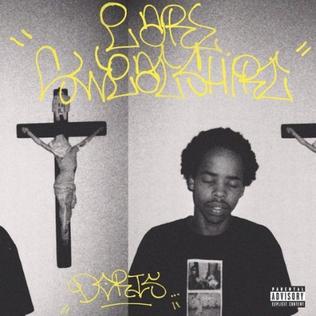
Drake has changed since Take Care. More swagger, more bragging and sadly less quality. Where Take Care at least painted a more sinister, more complex picture of the man, Nothing Was The Same is the album of a mediocre rapper that happened to end up doing okay. It is far from a bad album, it’s just an unimportant one.

Don’t get me wrong, he has some pretty good cuts on this album, but it’s the kind of album where the quite good The Language is followed by the absolutely atrocious 305 To My City. The grating thing is how far he seems to believe he has come. A song like Started From The Bottom is very listenable, if not particularly deep, but his boasts feel baseless. Wu-Tang Forever could have been a good song, but sampling that hook only reminds you just how soft Drake really is. Hold On, We’re Going Home is a good song, just not the groundbreaking release he seems to think it is. I’ll give Nothing Was The Same this though, listening to it did get me to listen to a lot of classic albums again, just to remember what exactly good rap sounds like.

To summarize, with Nothing Was The Same we have a passable rap album that will keep Drake up near the top of the charts. Listening to it again, it’s amusing how much the beginning sounds like 808s & Heartbreak. It’s as if Drake wants to tell us he’s years behind Kanye West. Also, what happened to 5 A.M in Toronto? That was Drake living up to the hype.

Janelle Monae: The Electric Lady

26 Sep

Janelle Monae always seems constrained. That feels like a strange word to label someone whose music defies every label applied to it, but it is the only one that seems apt. She has music, she has art and she has videos but none of those mediums seem able to completely hold all that goes on inside her mind. It was inevitable that her seven-part concept series Metropolis would be science fiction based as nothing else would fit the relentless degree of innovation that she pushes. Her latest installment, The Electric Lady, which serves as parts four and five, breaks away from her previous works to give us something personal, something new and something that truly lives up to the name Wondaland.

The first part feels more familiar, with an orchestral overture opening the album as did The Archandroid and the same jazzy pop and solid beats as her masterpiece debut. This time around she has a solid set of supporting artists. The keyword here though is support. Even Prince, who appears on the first song is clearly the guest in what is completely Janelle Monae’s album. Both of her singles, the excellent Q.U.E.E.N. (featuring Erykah Badu) and Dance Apocalyptic come from this half. This is music meant to be danced to, and while I can’t dance anything like her, I can’t sit still with music like this on either.

The world of Metropolis is sketched out by things like the beginning of Q.U.E.E.N. and fragments embedded throughout the album. The picture is still vague and while Cindi Mayweather (the Ziggy Stardust to Janelle Monae’s David Bowie) has definitely progressed along her path of becoming the android messiah, I couldn’t tell you exactly what she has done. This is an album though, not a novel, and the details are unimportant. What is important is the flights of imagination that it inspires and this set provokes creativity as well as anything I have ever experienced. Also, the DJ interludes are incredible.

The second half however is more of a soul album than anything else. This takes me pretty far out of my comfort zone as my foundation is far stronger with Asimov than with Sly, but her music is undeniable. This part showcases her voice, and while it is hard to isolate any single strength of Janelle Monae’s, her voice certainly has a good case for being the strongest of them all. It also gives her a chance to get a little personal than her android alter-ego had previously allowed. Suite V feels not only like Cindi Mayweather singing to her human lover but also a love letter to the classics of soul and funk. She does play with the standard structures and even drops a rap into the stellar Stevie Wonder-esque Ghetto Woman, but this an album from someone who clearly grew up with a love of the R&B greats. This is an intimate, soulful performance and would hold it’s own even if taken alone and not as a part of a larger set of work.

The Electric Lady is not just an album about the future, it is a blueprint for the future of pop, funk, soul and whatever else Janelle Monae decides to touch. While The Archandroid did push harder and better, this is the work of an artist that has moved far enough ahead that she can take a moment to stretch a little and look back on what she has come from. We are lucky that she shares it so well.

Maysa: Blue Velvet Soul

16 Sep

Blue Velvet Soul

The thing about soul is that it’s hard to pin down. It’s not as simple as identifying a sound or working off lyrics, it is actually a question of soul and that’s a hard quality to define. It is a quality that Blue Velvet Soul, the latest album by Baltimore native Maysa, has in spades however.

This album serves mostly as a showcase for Maysa’s voice, which is nothing short of gorgeous. She has a very powerful voice that works wonderfully over some very nice smooth jazz arrangements. Cuts like Quiet Fire are simultaneously soothing and uplifting. This album is the aural equivalent of a warm bath.

She does manage a very diverse set of songs with strains of jazz, disco, funk and even a little rap interlaced in the R&B. However, the album as a whole lacks challenge. This is pleasant, but not particularly stimulating. The lyrics also tend toward cliche when not meaningless. The intention was probably never to send you into innovative thought spirals, but the fact that this music is so easily digested makes it very hard for it to create a lasting impression.

This is a very fine album, just not a classic. For soul fans, this album will see regular rotation and it is worth a listen even if you don’t normally follow R&B, but it lacks the inspiration to take it from quiet to fire.

Major Arcana: Speedy Ortiz

8 Sep

Major Arcana


There’s a word for a band that decides to name itself after Speedy Ortiz, a tragic, minor character from the cult alternative comic Love and Rockets. That alone tells you most of what you should expect from their debut album, Major Arcana. There are songs about disturbing personal relationships, self-loathing and high school loneliness. There is also an exceptional degree of quality. This is one of the finest albums to come out in a year of great albums. So, there is a word for a band that names itself after one of the strongest moments of alternative comics. That word is apt.

To start with, the music is incredibly listenable. Speedy Ortiz have no problem showing you their influences. Pavement, Dinosaur Jr. and Slint spring instantly to mind and there are far worse bands that you could draw from. Every song is meticulously crafted and flows from section to section perfectly. The guitar work is solid throughout, providing a well-defined sketch for lead singer Sadie Dupuis to color in with her dark and personal lyrics. The music itself is intricately layered, with muscular, repetitive riffs throughout over which distortions, solos and voice work cavort. This is a strong, powerful work capable of holding your attention in its own right.

The lyrics however are astounding. Personal, deep and exquisitely written, the only problem I have with them is how easily they slip below the ever-exceptional music. The songs manage to slip below the skin, but no matter what snippet you sing along to, once you vocalize the words and the shock of what you are saying forces you to pay attention to the rest of the lyrics, you find yourself more and more drawn to the stories Ms. Dupuis is telling you. Just listen to No Below, listen to it right now, and tell me that these are not the words of someone who has thought hard and long about how best to express the truths of her life.

Major Arcana is not just an album, it is what the alternative rock albums of the nineties so often promised, and what only the best managed to deliver, a masterpiece that could be your entire life.

Daft Punk: Random Access Memories

14 Aug

In the late 90s, two Frenchmen released a landmark debut album that forced the world to reconsider its current taste in dance music. This album was followed in 2001 by an even more historic album that, once again, forced the world to reconsider. Ensconced invariably in metallic helmets and a coolness that doesn’t quit, Daft Punk have made it their job to redefine things for a world that is far behind the curve. What happens, then, when they choose to delve in the past rather than look towards the future?

Brilliance.

Random Access Memories

In May 2013, Daft Punk built a futuristic discotheque in space called Random Access Memories, and they’re inviting everyone to their party – not just the cool kids. Old-time artists sessions (Paul Jackson Jr., JR Robinson et al) form an intoxicating mesh of disco-jazz, while dreadlocked funk icon Nile Rodgers frets his way through the fabric of their material. Hip-hop/R&B superstar Pharell Williams croons in the foreground and Panda Bear is at the back selling acid tabs. And at the very middle of all this commotion are two robots, trying their very best to make music like they’re humans from the 70s.

Before RAM released, Daft Punk recorded disco king Giorgio Moroder talking them through his rise to fame. Eventually, they chose to include one snippet, heard on “Giorgio by Moroder”, about his involvement in the birth of disco music. “I wanted to make a record with the sounds of the 50s, the 60s, the 70s,” explains Giorgio in his clipped German accent, “And then have a sound of the future.” This is the defining sentence, the centerpiece and the crux of Daft Punk’s effort in this album. What Daft Punk tries to do on this album is what Giorgio tried to do all those years ago.

Giorgio Morodor on the cover of his '77 album From Here to Eternity

Giorgio Morodor on the cover of his ’77 album From Here to Eternity

But an ideological centerpiece is not all that RAM has. EDM (which, by the way, Giorgio Moroder basically invented in ‘77) in its modern form caters to humankind’s strange desire to sound more machine-like. But Daft Punk has, as usual, taken this idea one step forward. Random Access Memories is a story about humans that became robots and are trying to remember what it’s like to be human again. The robots try to access their half-forgotten human side through their random access memories. Get it?

The story starts off, in my opinion, right before Giorgio Moroder gives Daft Punk his clue of combining the past with the future. On “Lose Yourself to Dance” (a directive that really does result in full-body grooving) , we meet Pharell Williams at his absolute soul-funk best, in a jam with Nile Rodgers, who’s belting out the tightest disco riffs this side of the 70s. They create magic again on the spectacular first single “Get Lucky” which would be an honest-to-God hit in disco’s heyday. On both tracks, the Parisian androids are tinkering quietly in the background.

/

After Giorgio’s monologue, a few things change in the story. Album opener “Give Life Back to Music” is their distilled learning from Mr. Moroder: in order to create the future, revive the past. Pharell leaves, the vocoder enters, and Nile Rodgers continues to provide the funkadelic backbone. “Let the music of your life/ Give life back to music,” they implore, and you’re inclined to agree.

Pretty soon, though, the robot takes over the human. “The Game of Love” is about a robot emoting, almost like a human, about heartbreak and eventual acceptance, and on “Within”, the robot is slowly starting to lose touch with its human side completely. “There are so many things that I don’t understand/ There’s a world within me that I cannot explain,” laments a vocoder-edged automaton, amidst slinky piano and theatrical flourishes.

Thomas Bangalter (L), Guy-Manuel de Homem-Christo (R)

Thomas Bangalter (L), Guy-Manuel de Homem-Christo (R)

The storyline (and album) finds dead center on “Touch”, a magnificent magnum opus featuring the old-world folk voice of Paul Williams. The robot, expressing itself through Williams, asks how to relate its computerized memory of touch to the human feeling of touch; and after a full-blown blissful horn and gospel section, the robot realizes the answer is (of course) love. After this life-altering moment (“Sweet touch/ you’ve almost convinced me I’m real”), Daft Punk’s Random Access Memories comes full circle: about humans that slowly became robots, and are slowly turning back into humans. It will send shivers down your spine, I promise you.

Why aren’t the songs in chronological order? Because that’s not how our (human) brains work. Memories are distorted, rearranged and accessed (yes, randomly) by our brain; Daft Punk is trying to mimic that very phenomenon. The album title is really very clever, non?

Daft Punk makes music that foils critical analysis. They want to play 70s disco in their spaceship from the year 4000, because they think it would be a fun thing to do: and that’s their only reason. They are able to distill their playfulness and whimsy into a structured, inspired album – without becoming self-indulgent – and therein exists their greatness. Towards the end of “Giorgio by Moroder”, Giorgio leaves one final observation in the listener’s mind. “Once you free your mind about a concept of harmony and music being correct, you can do whatever you want,” he notes. Daft Punk understand this very well, and on this album, you will, too.

Best Tracks: Get Lucky, Giorgio by Moroder, Lose Yourself to Dance

Bonus:

Jay-Z: Magna Carta … Holy Grail

22 Jul

I’m sure no one doubts just how awesome Jay-Z’s life is. He’s married to Beyonce, worth hundreds of millions of dollars, undoubtedly one of the greatest rappers of all time, and married to Beyonce. Besides, he’s never been shy about telling us all of this. You can’t have a Jay-Z album without some self-congratulation in every song, and we love him for it. No, I don’t doubt that his life his awesome, just that his latest album is.

Magna Carta … Holy Grail is far from a terrible album. The beats are fine, there is plenty of classic Hov lyrics and flow and some truly exceptional moments. For instance, Jay Z Blue and Nickels and Dimes are both excellent by any standard and F.U.T.W. is quite good. However, these stand-out moments are the exception to the mediocrity that defines this album. Even worse, they are often balanced by moments best forgotten. Letting Justin Timberlake take the first 80 seconds of your album takes quite some effort to forgive.

At 43, maybe we should expect an album that is more business than rap, and certainly the strongest songs are only about topics Jay could address at this stage in his life – fatherhood and philanthropy. Whatever the reasons may be, the result is album best forgotten. This is promising to be a very strong year for rap, but Magna Carta … Holy Grail doesn’t hold a place in it.

Deltron 3030 at Stern Grove, San Francisco (30/6/2013)

1 Jul

IMG_0104

Deltron 3030 is a supergroup consisting of producer Dan the Automator, rapper Del the Funky Homosapien and Kid Koala. Their first and only album Deltron 3030 is a space rap opera that laid the seeds from which the Gorillaz were to grow. Their second album, Event II is set to be released this fall and they have started touring again. Today, they played the Stern Grove festival and they were incredible.

IMG_0100

The set started with half an hour of Kid Koala all by himself. With no laptop and no headphones, he took us all to school in the art of turntabling. He started with a homage to Louie Armstrong that could have slipped into Future Shock with no questions asked. From there he dropped an eclectic set featuring a Jay-Z beat, his four-year-old child’s favorite song and “a song for the 50-year old women out there”. In case you couldn’t tell, it was great fun.

IMG_0107

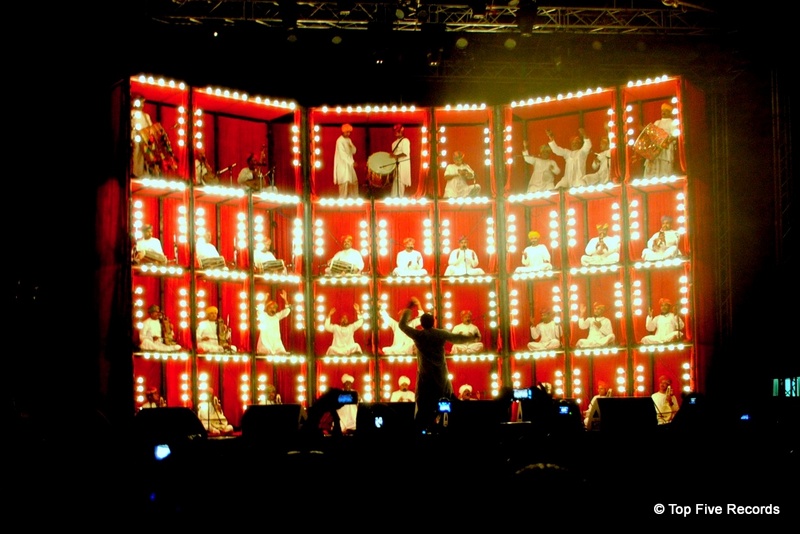
From there we had a lengthy break for set-up and then Deltron 3030 came out to 3030 from their eponymous album. This is my personal favorite Deltron song and it was excellent live. The song is marked by the soundscapes it presents and the backing symphony did a great job in setting the atmosphere. It was the trio though that owned the stage. With Del rocking a Star Trek shirt, Dan’s conductor guise and Kid Koala’s infinite charisma, they were by far the stars of their own show, as well they should be.

IMG_0111

The set was a pretty equal mix of Deltron 3030 and Event II songs, which was an interesting mix of familiar and brand new. Dan the Automator had to teach us the chorus of one of the songs before it started and then cued us in so that we could sing along. Of course, for Deltron songs, the crowd came in knowing the words. 3030, Virus, Mastermind, Positive Contact and Memory Loss all had the crowd pumped from the opening bars. The new songs gave this concert a freshness I have rarely experienced. If the purpose of this tour is to hype Event II, then it worked for me. I am definitely stoked for its upcoming release. Having said that though, the standout moment of the concert came with the encore when they dropped Clint Eastwood, a song both Del and Dan played pretty large parts in.

IMG_0116

Deltron 3030 was a landmark album and sounds as innovative now as it did nearly fifteen years ago. All three of the artists are rulers of the underworld in their own right and together they are unmatched. Their live show only bolstered my respect for them and I am very excited to see what will come next. This is the standard to which rap concerts should be held.