Seasons’ greetings to our readers! As Year Twenty-Twelve winds down, there are a few inevitable questions that arise. Why did the Mayans provide such an anticlimax? Will there ever be peace in the Middle East? What were the best albums of the year?
Unfortunately, prophecies and politics are not our forte, but we proudly share with you our take on the year’s best in music. From R&B superstars to British indie rock, Top Five Records covers the top five records (duh) from the year that was.
5. Jake Bugg, by Jake Bugg
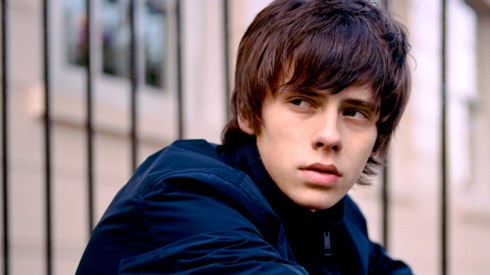
Young 19 year old singer-songwriter from Clifton, Nottinghamshire
Chiming in at number five is one of England’s finest singer-songwriters – and certainly the youngest. 1994-born Jake Bugg (né Jacob Edwin Kennedy of Nottinghamshire) impressively channels artists from at least thirty years before his birth in his eponymous debut album Jake Bugg. Yes, the overarching obvious influence is Bob Dylan, but there’s a healthy bit of Lonnie Donegan and Graham Nash in there too. The entire concoction is astounding for several reasons: he strums and finger-picks like he could be pals with Nick Cave; he writes and phrases like he could be a contemporary of 2005-06 era Alex Turner; and he looks like Britain’s answer to Justin Bieber.
Raucous skiffle/country stomp “Lightning Bolt” starts the album off on a rather good note, and sets the tone too. “Two Fingers” is a tribute to his life in Clifton: fat joints, too much alcohol, and an unnamed man in the house flinging curses at Jake’s mother, while “Seen It All” deals with pills, gangster crews, and the kind of parties where everyone carries a knife. Surely, it is enough to send a young man into spirals –Jake admits that he’s “run down some dark alleys” in his head. The lad’s appeal shines through in “Two Fingers”, though: his “Hey, it’s fine/I left it behind” closer adds that subtle touch of having ‘seen it all’ and being all the wiser because of it. “Ballad of Mr Jones” is a slow-burning epic about a powerless man who drunkenly takes things into his own hands; we guarantee that you spend the song thinking, How the hell is this guy just nineteen? The best song on the album, however, is still our old favorite. Jake Bugg’s album is an hourglass, with one bulb set in yesteryear’s bluesy tarnish and other set in today’s grisly reality – the best part is that you don’t even notice the sand flowing between the two.
Must check out: “Someone Told Me”, “Ballad of Mr Jones”, “Lightning Bolt”
4. Channel ORANGE, by Frank Ocean

Christopher Francis Ocean.
Clocking in at our number four is R&B critical darling Frank Ocean. Last year, Mr. Ocean’s mixtape Nostalgia.ULTRA topped many a critic’s list. The current member of oddball rap troupe Odd Future was an erstwhile songwriter for artists as varied and well-known as Beyonce, Justin Bieber and John Legend. But with his debut mixtape, Frank has decided to step out of the background, and has since then come into his own as perhaps the best R&B artist recording today.
Channel ORANGE was cleverly released in the very week that normally girl-lusting Frank Ocean confessed (on Tumblr!) to being in unrequited love with a man for many years. The shock surrounding the news, coupled with a series of shrewdly-timed interviews, meant that Frank was the biggest thing in music at that point. Happily, the album lives up to the hype.

Frank Ocean’s tell-all Tumblr post
“Forrest Gump” is about that same man, who ran Frank’s mind for a few years (Run, Forrest, Run. Get it?). On “Bad Religion”, he sings/confesses in earnest (“I could never make him love me/ Never make him love me”) to a taxi driver/shrink for the hour, and you’re left wondering if ‘he’ is the man in “Forrest Gump”, or God, who historically tends to frown upon homosexuality. Prostitute/Queen of Egypt mash-up “Cleopatra” is equally rich in religious motifs. (We wrote about it earlier this year.) But we felt that the best songs on the album arise when Frank pairs his emotional revelations with an R&B foil of sorts: such as Outkast’s Andre 3000 on “Pink Matter”, or our personal album pick “Super Rich Kids” featuring fellow Odd Future member Earl Sweatshirt.
What really strikes you about Frank Ocean is his ability to turn the hedonistic ideal on its head: that a life of drugs, alcohol and sex can rebound into a very acute sense of loneliness and defeat. Flip over to Channel ORANGE, asap.
Must listen: “Bad Religion”, “Super Rich Kids”, “Cleopatra”
3. Django Django, by Django Django

Art school kids from Edinburgh
Imagine that you live in a space station in year 2250 with the rest of the humans, decades after the Earth has proved uninhabitable. Imagine that you then decide to zap yourself back to ancient Cairo, find yourself a bodacious desert caravan, zap yourself forward to the Californian desert of the 1850s right into a spaghetti Western, and finally go on a caravan journey to the Pacific Ocean where you decide to go surfing. If you can imagine all this, then you’re prepared to listen to Django Django, the eponymous debut album by four of the finest specimens of Edinburgh’s art-school scene.
Even if you can’t imagine what we describe above, start listening. Django Django have made it easy for you to picture with the aptly entitled album opener “Introduction”, where synths from the future meet rugged outlaw whistles of Old West, while “Hail Bop” transitions seamlessly from this seething drama into almost a Beta Band-like classic, echo-y pop rock. (Interesting trivia: Django Django’s David Maclean is in fact the little brother of the Beta Band’s keyboardist John Maclean!)
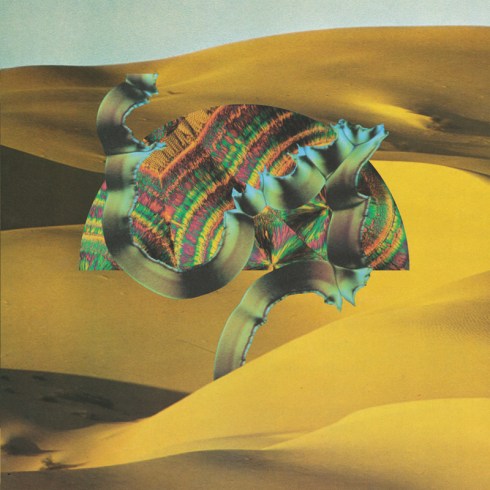
Django Django album cover
“Skies over Cairo” is a mind-blowing instrumental piece that could soundtrack a revamped version of the video game Prince of Persia if it were rewritten as a mystery-thriller, while “Zumm Zumm” heads south right into the sub-Sahara.
The album’s centerpieces, though, are the two singles that the band has released. “Default” jangles with unrelenting percussion, chant-chorus lyrics and synths straight from hyperspace, and is overall one of the catchiest songs you will hear in your life. MGMT only wishes they were this good. “Waveforms” is the other crowning glory in this overall glorious album. Starting off exactly like a Major Lazer song, the synth-drama slowly unfolds in a cerebral haze that is more organized that it seems on surface. The song ends with the entire band chanting a hypnotic mantra:“Touch it, break it, shake it yeah/ Take it apart and break it yeah/ Try to rearrange it yeah/ Couldn’t recreate it yeah”.
And that’s what the band essentially does. They take noises from various locations and time periods of world history, and rebuild it into a colorful kaleidoscopic juggernaut that is wholly organic and fully fantastic.
Must listen: “Default”, “Waveforms”, “Skies Over Cairo”
2. good kid, m.A.A.d. city, by Kendrick Lamar
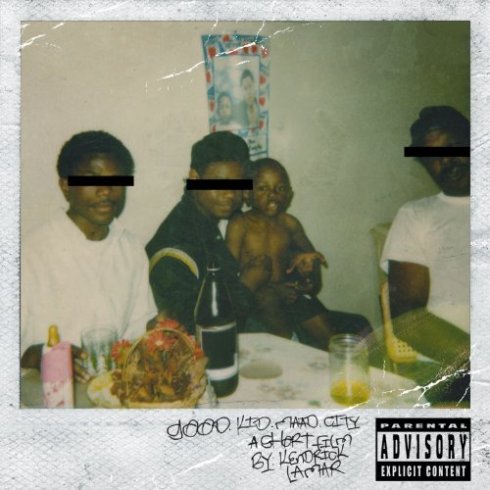
good kid, m.A.A.d. city: A Short Film by Kendrick Lamar
Straight-out-of-Compton Kendrick Lamar’s debut album, good kid, m.A.A.d city, is a meditation on what makes a classic, near-perfect hip-hop album. The album cover features a young Kendrick in the background and a tall bottle of booze in the foreground; Kendrick sets the familiar atmosphere that has consumed many a rapper: that of the over-arching influences of a mad city’s harsh realities, especially for a young black man. The difference between Kendrick and all those other rappers is the other element pictured on the album cover – family – because of which Kendrick managed to stay a ‘good kid’ despite Compton’s gang culture.
But that doesn’t make a classic hip-hop album: not quite. Kendrick is also an excellent rapper, an adept storyteller, and an intelligent young man, and is able to convey his thoughts in a killer flow over some seriously slick beats. Kendrick has correctly subtitled the album ‘a short film by Kendrick Lamar’. It’s a flipbook of glimpses into Kendrick’s life – from teenage lust and gang temptations to the maturity of young adulthood – and it’s so well-articulated that you could actually be watching a movie.

Kendrick Lamar Duckworth
On “Sherane”, a teenaged Kendrick drives out to his girlfriend’s house, mad with lust: only to stop short at her driveway at the sight of two hooded gang members; a voice mail from his mother, asking him to come back home, ends the song. The story continues in a skit on “Poetic Justice”, where he eventually gets jumped by the two gangsters on account of being on their turf. This event catalyses his thought process on “good kid”, where he realizes that he’s stuck between the ‘red and blue’ of Compton’s gangs and the ‘red and blue’ [police lights] of the bigoted cops. “I’ve never been violent, unless I’m with the homies,” explains ‘good kid’ Kendrick on “The Art of Peer Pressure”, and these are the same influences that he tries to overthrow on “m.A.A.d city”.
The album’s story arc – and Kendrick’s process of transition – finds its end on “Real”, in a heartbreaking skit with Kendrick’s parents. “Any nigga can kill a man, that don’t make you a real nigga,” his father tells him, “Real is responsibility, real is taking care of your motherfucking family, real is God, nigga,” while his mother chimes in with, “I love you, Kendrick.” Kendrick Lamar has created more than an album: he has actually written a poignant and all-too-real script of gang culture’s harrowing influence. We strongly urge you to listen to good kid, m.A.A.d. city. It’s a masterpiece.
Must listen: “The Art of Peer Pressure”, “good kid”, “Real”
1. Lonerism, by Tame Impala

Lonerism.
Over the course of the year, we have already sung numerous praises for Perth’s retro-psychedelic sensation Tame Impala. Over the course of the year, we also realized another thing: nothing else we’ve heard in 2012 has been able to match up to their album. The conclusion? Tame Impala’s sophomore album Lonerism is, in our honest opinion, the best album of 2012.
Yes, it is true, Tame Impala sounds like they might’ve fit in well in the late 1960s. Yes, it is true, lead singer Kevin Parker sounds eerily like Jim Morrison and John Lennon. But either one of those facts wouldn’t make them brilliant, or even that notable: psychedelic rock revivalists are a dime a dozen. Lonerism is special because Tame Impala’s band members have swathed themselves in the spirit of that bygone era so meticulously that they know no other way of making music; so that when the digital-age sheathes of synths (or any other elements) are inevitably added in, they seem perfectly organic even against the retro backdrop.
The umbrella theme on Lonerism stems from Kevin Parker’s acute introversion and subsequent loneliness. This manifests itself in songs that are at different stages of his thought process: from the suppliant “Why Won’t They Talk To Me?” to the resigned “Keep On Lying” to the wonderfully nihilist and expressly titled “Nothing That Has Happened So Far Has Been Anything We Could Control”.

Perth boys
The whole album is a giant trip; and each of the songs is, individually, a mini-trip that swirls and floats around in your head, with enough small quirks and strokes of genius embedded in the album to leave you spell-bound. There’s that moment on “Mind Mischief” when the strobe vocals and atmospherics wind down by a fraction to surface a guitar riff. There’s that moment on “Sun’s Coming Up” where the mournful piano ballad unexpectedly switches into hopeful, reverb-heavy wah-wahs: like musical sublimation. There’s that moment on “Keep On Lying” when the guitars, drums and non-diegetic laughter suddenly sync up, and a new phase of the song begins. These magical moments can and will vary for each listener and listen, which means that Lonerism is that rare, ever-replenishing goldmine: a classic.
“Elephant”(music video!) is an unrelenting, mind-blowing animal of a track that overtakes your entire mind for a few minutes; Tame Impala hypnotize you into their world with cymbal crashes, drum rolls and that bassline, dear God. Fluffy white clouds float lazily by in an azure sky on “Feels Like We Only Go Backwards” (music video!), and you’re too headily high to notice what Parker’s really saying (“But I got my hopes up again, oh no, not again/ Feels like we only go backwards darling.”). “She Just Won’t Believe Me” is a snatch of four-sentence brilliance, like a mistakenly-tuned radio station.
We tried, but we just couldn’t stop ourselves from describing nearly every song on this album.
Tame Impala’s Lonerism sounds like that one unforgettable stoned reverie (we’ve all had one) that you had in college when you were tripping on weed and listening to ‘60s psychedelia. If you like The Doors, post-Revolver Beatles, early Pink Floyd or getting high, you will love this album. Even if you don’t really like any of these things, you’ll still like Lonerism. We guarantee it.
Must listen: “Elephant”, “Keep On Lying”, “Mind Mischief”
Agree with our top five? Disagree? Let us know in the comment section below!
Tags: best albums, best albums of 2012, best of 2012, channel orange, django django, Frank ocean, good kid, Jake Bugg, kendrick lamar, Lonerism, m.A.A.d city, maad city, mad city, tame impala, top five albums